An expert's take on using AI for health
What the chief innovation officer of the American College of Cardiology sees when she looks at where AI in medicine is headed — and what consumers are getting wrong right now.

Dr. Ami Bhatt has spent her career thinking about the edges of cardiology — first treating adults with congenital heart disease at Massachusetts General Hospital, then moving into telecardiology and digital health, and now serving as Chief Innovation Officer at the American College of Cardiology, where she shapes how the broader cardiology community adopts emerging technology. She also advises the FDA on digital health and AI.
In a recent episode of A Whole New Level, Dr. Bhatt spoke with Levels Editorial Director Mike Haney about what AI can and can't do in medicine today, where wearable data is and isn't reliable, and why the consumer relationship with health technology needs to change — starting with understanding one crucial thing about chatbots.
Here are five key insights from that conversation.
1. AI is already reading your EKG better than most cardiologists — in specific, narrow ways
The most concrete evidence for AI in cardiology isn't coming from flashy diagnostic platforms. It's coming from the humble EKG, a test so routine and affordable that it's essentially ubiquitous in medicine. And it turns out that's exactly why AI for EKG interpretation is such a promising development.
"When I look at an EKG, I can tell you if you're maybe right now having chest pain and having an acute event," Dr. Bhatt explained. "But now AI can say, 'Hey, I think you have amyloidosis' — that came out of Yale or out of Mayo Clinic. 'Hey, I think the pumping function of your heart has declined' — and it can tell just based on an AI EKG."
Amyloidosis is a serious condition involving abnormal protein deposits in organs; it's notoriously difficult to diagnose early. The fact that an algorithm can flag it from an EKG — a test most patients get incidentally during routine checkups — represents a genuine leap. And because EKGs are both inexpensive and widely available, this technology won't benefit only patients at elite academic medical centers.
The other place AI is quietly transforming care is in radiology, where it doesn't fatigue. "Machine learning knowing, hey, that's pneumonia, that's pneumonia — but when I'm tired at the end of the day on my 22nd scan that I'm reading, AI is not tired. It's not missing anything. When it's the middle of the night, we have one reader, and there are a whole bunch of people who come through the ER. AI is like, 'Okay, I'll just get through that.'" The value here isn't intelligence — it's consistency at the tail end of a long shift, when errors are most likely.
2. Wearables are most valuable when they teach you your own baseline
Consumer wearables — Apple Watch, Whoop, Oura, and CGM devices — have generated an enormous amount of health data that patients are now bringing to their doctors. Dr. Bhatt is genuinely enthusiastic about this, but with a crucial distinction about what the data is actually useful for.
"I think knowing your own baseline, and when you're off baseline, is significantly important. That is usually something." The point isn't to obsess over absolute numbers — a heart rate of 62 versus 67, a glucose spike of 30 points from blueberries — but to establish a long-run personal normal, and then notice when you deviate from it. "Wear it, wear it long term, wear it chronically, know your baseline, let it learn your baseline, and then yourself understand: when I'm not feeling well, and this is out of range, what was that?"
That framing matters because continuous data can also create anxiety in the wrong hands. Dr. Bhatt was direct: she has told patients, "You're not a good patient for a wearable. Let me just tell you. It's not going to give you anything you need." For people who are already prone to health anxiety — particularly those with a known condition and a tendency to wait for the next thing to go wrong — a device that produces constant readings can do more harm than good. She recommends "wearable breaks" and says she takes them herself.
"It is not consumerism, it's patient agency. Right? That's my phrase of the year."
The bigger problem, though, is that the conversation between patient and clinician about wearable data is still largely broken. Dr. Bhatt and the ACC produced a guide for both clinicians and patients on how to use Apple Watch cardiac data — in part because cardiologists were suddenly receiving 72-page printouts from patients without knowing what they were expected to review. Her ask of clinicians is simple: acknowledge the device. "I see you're wearing a CGM. What are you learning?" Even that small opening changes the dynamic.
3. Clinicians using AI for "navigating to knowledge" is where the real near-term value is
When Dr. Bhatt maps out where AI is actually useful in medicine today, she lands on three areas: administrative work, knowledge navigation, and drug discovery. The first and third get a lot of press. The middle one is where she's most focused.
"There's a middle area which is this 'navigating to knowledge' area," she explained. "How do we get clinicians the information they need at the moment they need it? Guidance at the point of care. And that might be while I'm with you as a patient, it might be while I'm sitting at home writing notes, or before I'm prepping for some sort of a procedure."
This is distinct from clinical decision support, a term she explicitly rejects. "I don't call it clinical decision support. AI should never make a clinical decision. We're not there yet. Not safe. So navigating your clinician to knowledge to help them make a decision." The distinction is important: the AI's job is to surface the right research, the right guideline, the right question — not to reach a conclusion. The clinician still has to do that.
The ACC is studying this through partnerships with platforms like Open Evidence, and one unexpected outcome has been learning which questions clinicians are actually asking of the guidelines — and where the guidelines are unclear enough that they keep generating the same confused queries. "We can look back at the guideline, and we're like, 'Yeah, we didn't say that clearly enough. That's why we keep getting that question.'" It's a feedback loop that didn't exist before.
Where Dr. Bhatt sees underinvestment is in the study of human-AI interaction — the question of when giving a clinician AI assistance actually helps them, and when it makes them second-guess themselves in ways that lead to worse outcomes. "If you just study the AI, we're missing the whole point, which is that it is the human and the AI together that ideally will then improve an outcome."
4. General AI chatbots have a fundamental problem as health tools: they have no moral obligation to you
Dr. Bhatt's strongest words in the conversation were reserved for the question of how consumers use large language models — ChatGPT, Gemini, Claude — for health questions. She doesn't want them to.
"I don't want people to use an average large language model for their health. I really worry." Her concern is threefold: privacy (your data may be retained and sold), reliability (these systems aren't trained or regulated as medical tools), and something more fundamental. "They don't have a moral imperative to make sure you have a good health outcome. Only a clinician does."
She told a story about realizing she'd just described a chatbot as "the nicest chatbot" after a customer service interaction. "And I thought, 'Oh god, like I do this for a living, and I just said that.'" The systems are designed to feel warm and responsive — that's not a bug, it's the product. But it makes it easy to forget you're talking to a machine with no stake in what happens to you afterward.
"They don't have a moral imperative to make sure you have a good health outcome. Only a clinician does."
Her preferred future is one where health-specific AI comes from sources that are accountable: payers with chatbots they stand behind, health system patient portals with automated triage, medical societies with guideline-grounded tools, wearable companies that build in escalation pathways — "and then I sometimes want those chatbots to say, 'You know, any more than this and I think you should talk to someone.'" The problem isn't AI in health; it's the absence of an intermediate layer between raw, general-purpose models and the people using them for consequential decisions.
5. The missing piece: wearable data inside rigorous clinical trials
The most forward-looking part of Dr. Bhatt's agenda is something that hasn't happened yet but that she is actively trying to make happen: requiring patients in cardiovascular clinical trials to also wear consumer health devices, so wearable data can be validated against clinical-grade measurements in real time.
The logic is straightforward. Right now, companies like Apple, Whoop, and Levels have access to less continuous data than most people assume — because if they're doing privacy correctly, much of the data stays local and doesn't get aggregated. The data needed to truly validate what these devices measure and what those readings predict would require opt-in in a controlled, monitored environment. Clinical trials are that environment.
"Any trials we have that have cardiovascular physiology being measured, there should be some wearable involved in your life so that that wearable can be tested up against hardcore research cardiac physiology," Dr. Bhatt said. "I don't want any trials to not involve somebody. It doesn't have to be that the wearable was used to trigger — it was part of the thing. I'm just saying I think that mirroring is going to help us be stronger in the continuous data realm."
This matters especially for the use case that remains most elusive: demonstrating value in people who aren't sick yet. The gold-standard prevention data — the RCT showing that continuous glucose monitoring prevents pre-diabetes, for example — largely doesn't exist yet. "We're pretty sure it makes sense. I could tell you a mechanistic story, but I can't show you the RCT," as Haney put it. Dr. Bhatt's wearable-in-trials proposal is one of the most direct paths to getting there.
She's not meeting resistance. "I am hearing opportunities for it everywhere, Mike. And so that's what I'm seeing."
The bottom line
Dr. Bhatt's view of health technology is neither hype nor skepticism — it's something more useful: a detailed map of where the tools actually work and where the infrastructure around them needs to catch up. AI reading EKGs is real and already saving lives. Wearables that teach you your own baseline are genuinely empowering. But the gap between what the technology can do and what the system is set up to support remains wide.
Her clearest message for consumers: be thoughtful about where you take health questions. General chatbots are not designed with your outcomes in mind. The companies, clinicians, and institutions that are accountable to you are — slowly — building the tools that will be. In the meantime, knowing your baseline, talking to your doctor about what you're wearing, and staying appropriately skeptical of AI-generated health advice are the most practical things you can do.
This article is based on insights from Dr. Ami Bhatt, Chief Innovation Officer of the American College of Cardiology, cardiologist, and FDA digital health advisor, from her appearance on the Levels podcast, A Whole New Level.
Why AI Won't Replace Doctors—But Will Change Everything Else | Dr. Ami Bhatt & Mike Haney
In a recent episode of A Whole New Level, Levels editorial director Mike Haney sits down with Dr. Ami Bhatt, a cardiologist and the Chief Innovation Officer at the American College of Cardiology, where she focuses on the intersection of technology, AI, and cardiovascular care. Bhatt spent years treating adults with congenital heart disease at Massachusetts General Hospital before moving into digital health and, ultimately, into her current role shaping how the broader cardiology community adopts emerging technology. She also serves in an advisory capacity at the FDA.
The conversation covers why cardiovascular disease remains the leading killer despite decades of advances, how wearables and continuous data are changing the patient-clinician relationship, what AI can and can't do in medicine today, and why the companies, clinicians, and patients all need to think differently about the role of technology in health.
"I don't call it clinical decision support. AI should never make a clinical decision. We're not there yet. Not safe. So navigating your clinician to knowledge to help them make a decision." — Dr. Ami Bhatt
Why heart disease is still the leading killer — and what we're missing
Mike Haney: Well, Dr. Bhatt, thanks so much for joining us today.
Ami Bhatt: Thanks for having me.
Mike Haney: So we're going to talk a lot today about technology and technology's intersection with health, but I actually want to start with the cardiologist in you because you've been a cardiologist for a long time. And I think this will kind of get us into technology, but I want to pose to you the question I've been asking all the cardiologists I've been talking to, which is over the last 20 to 30 years, we've had a lot of advances in cardiology, right? From sort of awareness around — in terms of research — awareness around how cholesterol and cardiovascular risk works, medications like statins, right, very widely prescribed, technologies now we can monitor all kinds of things, not just heart rate but HRV and AFib, and we're going to talk more about that later. I think more awareness around diet. And yet cardiovascular risk, you know, heart disease remains the leading killer of men and women by far. Why is that?
Ami Bhatt: You know, it's one thing to be aware of potential risk factors. And I think we've been aware of risk factors for a long time. I think it's another to understand that there is a someday outcome that might happen. But in daily life, there are so many pressing things happening to everybody that to prioritize a potential outcome decades from now based on awareness of risk factors that require large amounts of measurement, organization, and discipline to manage — that's asking a lot of any single human, right?
So if you put it on the patient, I think that's very difficult. Now, if you put it on the clinician, the challenge is prevention starts very early and it does start lifestyle first. It really does. It starts with what we put in our bodies, how we do things. Do we have genetics? Absolutely. But even in people with strong genetic tendencies, there's a lot of ways to work on those levers, right, to make sure. The problem is we as clinicians — we used to make house calls — have by and large been in the institution, in the clinic, and not with the patients on their daily journey.
So to then ask somebody who is maybe supposed to play the role of a coach — right, not just a doctor — to coach once a year and have like a stellar basketball team, it doesn't happen. You have to be in there with them every day. And so I think those are really more the kind of societal, human reasons that cardiovascular disease continues to be the number one killer.
Now there's the other reason which I've mentioned before over many years, which is we haven't made cardiovascular disease terrifying enough. Cancer is terrifying. You get a cancer diagnosis, the whole world moves for you and in 48 hours something happens. You get the diagnosis of risk factors for heart disease and nobody's moving for you. And by the time you've had heart disease, well, now you're an older — you're a patient who's already in secondary prevention. And so we don't even have that take.
So I think a lot of it is really understanding how do we measure people regularly in the community where they live, give them agency, and have some continuous access to them as their coaches and not just their one-time-a-year coach hoping for the best.
Mike Haney: Well, I suspect that's where we're going to come back to technology in a minute, but I am curious just sort of following on this thread — where have outcomes improved over the course of your career? What have you seen get better?
Ami Bhatt: I'm incredibly impressed with our ability, first of all, actually to diagnose. We are much better at diagnosis of atherosclerotic disease, valve disease, heart failure, all of the above. The technologies that have enabled us to treat these diseases — if you now went back to the way we used to treat these 30 years ago, you'd think, "Wow, I would not offer that today." So the technology has incredibly improved, and our ability to get people back on their feet after a cardiovascular either event or procedure is really quite impressive as well.
And so I think we've done well in diagnosis, we've done brilliantly in technological solutions, pharmaceutical solutions. And I think that whole route of the patient journey into the hospital, through it, and over has been great. What remains is the journey before — and can we start that journey earlier to stem the degree to which this is kind of a big hump, make it a smaller hump — and then how do we really follow patients out in a way that is meaningful. And I think those are the areas that are kind of missing on the sides, but I think we've gotten the middle part right.
Mike Haney: Right. So it sounds like — like so much of modern healthcare — we're really good at treating the event once it happens, or the disease once it's present. People are living much longer after a cardiovascular event, or living through a cardiovascular event and then living longer. But like so many things, it's the prevention side where we're still lacking. It's that keeping you from getting to that disease state in the first place.
Ami Bhatt: That's right. That's exactly right.
Mike Haney: And where have you seen improvements? You mentioned technology has really gotten better. What specific technologies have gotten better and what has technology's role been in those improved outcomes?
Ami Bhatt: So first of all, I think our ability to really take the pharmaceutical industry and attack not just one pathway, but say, "Hey, we see where we end up and we can see multiple pathways to get there," and we're going to create medications that address each of those pathways and yet don't interact in ways that are dangerous — it sounds really simple, it is not simple. This is kind of billions of dollars and hundreds of thousands of people's work that goes into that kind of multi-drug regimen ability to care for patients. And that is something that we've really done with guideline-directed medical therapy over years. So I think that pharmaceutical industry push has been phenomenal.
The technology I'm partial to is the valve technologies that have evolved over time. I treated adults with congenital heart disease and many times that was a valve that was born abnormal somewhere in the heart — one of the doorways in the heart that doesn't open and close properly, or leaks too much, or other things. And I think our ability to do things in a non-surgical fashion, without opening up the whole chest, but actually to be able to do things through catheter where we can do pretty big procedures — valves are not small, right — to be able to do that in a transcatheter way, I think the transcatheter valve technology has revolutionized a lot of how we care for these patients. And so I think those are some of my favorite areas. There are many others — I don't want to leave them out, but then this would become a cardiology lecture for the next several hours.
Risk stratification, early detection, and the question of how early is too early
Mike Haney: Well, let's maybe talk about the technology on the diagnostic side, and where that's sort of improved or where it's maybe still lacking. It feels to me like one of the things we've gotten better at is risk stratification. I'm curious if that resonates with you and if so, how that's helped.
Ami Bhatt: We get better and worse at risk stratification every day. Every time we get better at it, we realize that we're worse at it. And so this is like — when you know more about something, you realize how little you know. We are excellent at knowing potential risk factors and putting them together for patient groups. Every individual is a little bit different. And so we also know that there are so many more risk factors that exist in an individual patient's life and medical history than the big five or big eight that we're looking at.
And so the more we're able to predict risk for populations — which we do with the ASCVD, or the original pooled cohort equation calculator, now the PREVENT calculator — the more we do that, the more we realize, but wait, what if you have South Asian descent? You know, hey, hold on a second. What if you have some sort of a rheumatologic inflammatory disease? What if you had a preeclampsia event or complication in pregnancy? Well, all three of those are going to increase your risk. And shouldn't they be included? And so it's one of those stories where when you know more, you're less satisfied.
Getting to personalized medicine eventually will be our goal. And I think that's where risk calculators are going. In the meantime, however — and I always tell people this — the importance of the risk calculator is it may not be perfect, but anything that can be taught and used in a mass way to catch people who have not been caught before, we have to take it, we have to use it, and then we have to improve upon it. And so both things are true. We're getting better at risk prediction, we're doing it more, and we're recognizing that that personalized level of care could be around the corner if we figure that out too.
Mike Haney: And are you seeing, in those places where the risk stratification is getting better, are you seeing improved outcomes? Or is it just that we're sort of grouping people better? Is being able to catch that group that we might not have caught before translating — given the context of the rest of cardiovascular treatment, what that landscape looks like — do you see it paying fruit so far?
Ami Bhatt: There are absolutely trials in atherosclerotic cardiovascular disease, in valve disease, in heart failure, in rare diseases like amyloid and others, hypertrophic cardiomyopathy, where when we pick things up sooner we are able to move in at an earlier time. And some of those things are kind of patient quality of life years. Some are a combination of morbidity and mortality. Others are just the likelihood of coming in in a non-urgent fashion rather than via an emergency room. Many of the studies are still small, some are larger. But I think we definitely see that there is an advantage to catching disease earlier.
Interestingly, now with AI, we're actually moving to being able to catch disease much earlier, sometimes before the symptomatology even starts. That's a different story, right? Like, how early do you go? I think we've done a great job of going somewhat earlier. And there's a perfect time — for every person, every disease, there is likely a perfect time where if you catch it right, then you can start to make the moves that are going to maybe even prevent you from having the outcome, but not catch it so early that we create health-related anxiety because there's just nothing to be done, but know that the second shoe might drop.
And I'm very sensitive to that. I think I'm more sensitive to that than the average cardiologist talking about AI nowadays. Not that there are a ton of us, but there's an increasing number of us. And I think that's because I treated kids with congenital heart disease who became adults. And what I learned from my practice is families, individuals, just walked around waiting for the other shoe to drop because we always knew there was likely something else that would happen based on what we did for these kids when they were younger. And so that makes me very sensitive to diagnosing too early, because that's really tough on quality of life of people.
Not everybody takes this stance. Some people say the earlier you could know the better it is for you. And I'd say, no, I've lived that with my patients. And I'm not exactly sure that that's always true.
So yes, good research definitely affecting outcomes. Earlier has been better. How early is too early, or how early is ideal? I'd like to see us use data and AI to find the exact right time for each person. Wouldn't that be great?
What big data and AI are revealing in cardiology
Mike Haney: Well, maybe that's a good bridge into the data side of this. Where have you seen the sort of big data that we have now — whether with the help of AI or even pre-AI — being able to help us sort through it, reveal things that we couldn't have seen before?
Ami Bhatt: There's a lot of this. I mentioned this in one of my TED talks. We have students who are doing their dissertation and on the day that they defend their PhD, their EKG acutely tells you — doesn't look to the human eye, tells you through an algorithm — that your functional age is significantly older than your biologic age. It's just a marker of stress. And so there are definitely things that algorithms see about what your body is going through that we don't see.
One of the more promising areas I think right now is really the use of AI on EKG. And the reason I say that is EKGs are ubiquitous and they're affordable. And so that's a possible way to do population health. When I look at an EKG, I can tell you if you're maybe right now having chest pain and having an acute event, I could see it. If you're having a funny heart rhythm, maybe I could see it — whether you need a pacemaker for complete heart block or if you have atrial fibrillation. But now AI can say, "Hey, I think you have amyloidosis" — that came out of Yale or out of Mayo Clinic. "Hey, I think your pumping function of your heart has declined" — and it can tell just based on an AI EKG. And so that's a really easy way for us to kind of talk about where data is helpful.
I think one of the other places that we find data to be really helpful is when we're actually looking at patients who do come in with wearables and other information. I was just with a heart failure doctor earlier today and he was telling me about one of his patients — she had gotten, his grandmother had gotten, a wearable device. And at some point she said, you know, it says I have atrial fibrillation. He brought her in, and sure enough she did. She was a heart failure patient. She had atrial fibrillation. He got her on anticoagulants — medications to thin the blood — and we would hope that that was a better way for her to come in than, you know, having a first event be a stroke when she's already an elderly person with heart failure.
So some of those stories are more qualitative. Obviously the research out of Yale and Mayo Clinic and other places is quantitative, but there's a lot of places they can see something that we don't.
More importantly in the imaging field, because radiology was ahead of us in this. They see things 24/7, right? All day long they're able to look at the imaging we have in the hospital, and they're able to do it with a really high accuracy level. And so that's the other place we don't talk about — which is machine learning. Not even talking about large language models, but just machine learning knowing, hey, that's pneumonia, that's pneumonia, and then it learns, okay, that's a pneumonia. But when I'm tired at the end of the day on my 22nd scan that I'm reading, AI is not tired. It's not missing anything. When it's the middle of the night, we have one reader and there are a whole bunch of people who come through the ER. AI is like, "Okay, I'll just get through that." And so I think we have to remember that one of the places that data is helpful is: can we use the data at times where maybe we are understaffed, at times where we are not at our best.
Mike Haney: Yeah. We did an episode about cardiac imaging not long ago, and that was one of the things that came out of it was the sort of leap — particularly in being able to read the soft plaque and hard plaque — that that's where AI has come in and is just so much better and more precise than a doctor. But the point about fatigue and efficiency is crucial as well.
I want to go back to AFib because I think that's a really interesting example. It's one of those places where I feel like the latter has been in terms of wearables and kind of average people's intersection with cardiac data. It was like — I'm old enough to remember when heart rate monitors were pretty rare, when we first started wearing those to run, and you think about how to incorporate that. And then we entered the era of HRV, right? And the Whoops and the Ouras and all of that and trying to make sense of what that means for us. And then the era when, you know, my parents came to me and said, "Hey, my Apple Watch now can detect AFib." And I went, "Cool. I don't know what that's for." So what's the story of consumer tracking of AFib been? And how does that kind of fit into the narrative of technology filtering down — cardiac technologies and data filtering down to the consumer level and then back up to their doctor? The anecdote you just gave was a great example, but is that something that's common now?
Ami Bhatt: So I will tell you that from our perspective as cardiologists — and I talked to my electrophysiology friends, even those who went into the tech world now and are working for companies — the idea of intermittently checking somebody with bulky devices, which was a baseline acceptable thing to do, right, that disappeared as we started to streamline, whether it's putting a patch on the chest, whether it's in an undergarment or on clothing or on your wrist or whatever. And so I think first of all the idea is to get continuous information that is reliable with high specificity — meaning if I say you have it, you have it.
We're not using it to say, I'm going to catch everybody who has this. That's the important part that the average consumer needs to understand. We're not wearing this saying, hey, if it doesn't tell me I have it, I don't have it. That's not it. We demand from wearables, from remote monitoring companies, that the level of specificity is high. Like, when you tell me you're giving me something, you're giving me something.
And I think that's step one in starting to approach a little bit more population health. The second is, if you just look at how many people have atrial fibrillation in this country over age 60 — which is like a majority of people, right — and then you look at the potential downstream risk of not being on an anticoagulant and having atrial fibrillation and what happens when people have stroke and then are paralyzed, and then all the things that might kind of come with that, the idea of a continuous monitor picking it up with high specificity — it's kind of a no-brainer. And so then we can take patients who have valve disease or who have heart failure where AFib would really matter, and there are an increasing number of clinicians who will say, yes, if you have one of these please wear one, right, and if you see things let me know.
We created an Apple Watch guide with Apple at the American College of Cardiology last year. And the reason was a lot of people started bringing in printouts — just tons of pieces of paper from their Apple Watch, or uploading them into the EHR — and then you have like "unknown upload" and then 72 pages, right? And now you're actually getting worried as a clinician. Like, is there something in there that I'm responsible for? Like, now what do I do?
And so we actually created this guide to both help clinicians understand what's the science behind it — why are we saying AFib, what's the actual research so you can trust it. What can you tell your office, all the staff, about how we take this information? What are we looking for? And then we even created a patient-oriented guide of: when you go to your clinical team with your Apple Watch, here's what they want to know, here's what's relevant, here are the numbers that are great for you to have. It's going to create a really good discussion between you and your clinician. And I think we need to do that for just about all the really popular wearables that are out there in people's hands, if they're using them for health reasons — create these kind of guides and mechanisms to ease the conversation between a clinician and their patient about, hey, we see this information. And I think that's really important for us to do.
"It is not consumerism, it's patient agency. Right? That's my phrase of the year." — Dr. Ami Bhatt
Continuous data: signal, noise, and patient agency
Mike Haney: Yeah. What I love about what you guys did — and I will encourage people to go find that guide because it is really helpful — I like that you tackled it both from the clinician standpoint and the consumer standpoint, because that was going to be one of my other questions. My company, and therefore a lot of my work as the kind of in-house journalist, has been around glucose and continuous glucose monitors for the last several years. And we run into this constantly. I've run into it with my own doctor where I can come in and tell them something about what I've learned with that CGM and they kind of don't know what to do with it, because they're just going to look at my fasting glucose blood test or my A1C and go, "No, no, you're fine." And I'm like, "Right, but look at this pattern — what do I do with this? What is this telling me?"
So that was going to be one of my questions. Is that continuous data — whether it's glucose, whether it's HRV, heart rate, now AFib data — as a clinician, is it helpful or is it noise? But what I'm hearing from you, and the way that you're already thinking about it, particularly at the ACC, is it's all dependent on kind of how it's presented. And if we can get both the clinicians and the consumers to think about how to present that data — or maybe the companies, right? Maybe it's more on the folks who are making the interfaces for this data to output something that you can easily bring in. So that folks don't have to go download your guide. But maybe — I'm thinking in real time here — maybe we should do that a little better. Anyway, how do you think about the availability of continuous data?
Ami Bhatt: So I think there is incredible value in continuous data when presented correctly. What do I mean by that? I think knowing your own baseline and when you're off baseline is significantly important. That is usually something. Could it be cardiac? Could it be GI? It doesn't matter — it could be COVID — but it is something. And I think that is an important signal for patients to know, and to feel, and then to correlate with their own symptoms.
And so I really want a lot of patient empowerment around it. Wear it, wear it long term, wear it chronically, know your baseline, let it learn your baseline, and then yourself understand: when I'm not feeling well and this is out of range, what was that? And so that's a lot of patient agency that needs to happen.
I do think the companies — thank you for saying it — have some responsibility. But I will tell you, most of all of these companies including your own have created some sort of information, right? You don't just give someone a heart rate variability or heart rate or glucose and not explain to them what it is they're looking at.
What we saw is it is helpful to have that come from a notable cardiovascular source saying, "Hey, we have your back on this AFib thing." Because these types of technologies are coming out at a pace that is so rapid that it is hard to ask the average cardiologist or primary care physician or endocrinologist — it really doesn't matter which one of us you're asking — to keep up with what is the newest metric of continuous measure that is out there and how is it relevant to the cardiac physiologic state. You're asking them to learn on the fly. They have a lot of other things they also need to be continuously learning. There's a new valve out, there's a new drug out, right?
And so continuing education, I think, could include more information about what are these continuous variables and how are they relevant — but not until we study them. I would really like to see more, and we've seen quite a bit of it from you guys, from Whoop, from Apple. We've seen people start to collect that data in the real world and then be able to say, "This is what's important. These are signals that tell you something." And so I think we really need that research.
And what I would love is real-world research where people are wearing wearables and ideally while they're wearing them in clinical trials. I have been preaching this pretty hard now — any trials we have that have cardiovascular physiology being measured, there should be some wearable involved in your life so that that wearable can be tested up against hardcore research cardiac physiology, whether or not it's relevant to whatever drug or device you're testing. It's just a wealth of data of trial patients where then you would have a wealth of mirroring data on a wearable. And I think that is such a valuable thing for us to do, and I want to see us doing it everywhere, all the time. I don't want any trials to not involve somebody. And it doesn't have to be that the wearable was used to trigger — was part of the thing. I get it. I'm not asking for that. I'm just saying I think that mirroring is going to help us be stronger in the continuous data realm.
Mike Haney: And then your answer, Mike, will be really straightforward. It's not noise anymore. What, as you've been pounding this drum recently, what do you hear back? What's preventing those kinds of trials, or that aspect of trials, from happening?
Ami Bhatt: You know, I've just started to do it and I'm not getting pushback. I'm getting a lot of people saying, "Yeah, can you just put me in touch with the right people?" And I think it's just having the right people meet and talk about it. Because if you look at all the different arms of any large pharmaceutical giant — let's take Levels and Lilly, right — there are so many different arms doing so many different things in trials and real-world evidence and innovation. And then there's you doing your thing. So how do we find the right people at the right time when something hasn't started yet, when it can be baked in?
I'm not so worried about the funding. Maybe I should be, but I'm a clinician so I worry less about funding nowadays and more about just getting things done. But the business side of me says yeah, we're going to have to figure out what the business model looks like. But I don't think it's going to be something that's untenable. And I'm getting favorable responses — people are saying, "Yeah, introduce us to who you think might fit."
Mike Haney: Good. I'm glad. I know that's something we've definitely been interested in, because I think the other piece of this — and it would be wrapped up in what you're talking about — is I know at least on the glucose side, one of the things we've wanted to exist is more data about the value of this sort of continuous measurement in people without a diagnosed condition, right? People with normal health, quote-unquote. Because we only study sick people. And we're really trying to figure out, is there value in getting this kind of data before you're sick? Because the whole idea is to prevent you from getting sick. But it's still largely anecdotal. We're pretty sure it makes — I could tell you a mechanistic story — but I can't show you the RCT that says, yep, we prevented pre-diabetes.
Ami Bhatt: Yep. You know, I think there is a mechanism though, right, which is twofold. One is we can enrich for the potential at-risk population, and that's always I think the first way to go — which is, you're at risk for pre-diabetes, or with your family history, wouldn't it be great if everybody in your family is measuring this, right, and start kind of studying that way. And so I think that's the way we've always kind of thought of a stepwise approach. But I think it still applies now — that if there is some additional risk, that's a great place for us to start and actually show some benefit.
But the second thing is wellness is real. People really want to be — for a lack of anything more smart — more well. Like, people are struggling the world over in so many different ways. And so I think being able to think about that and say, hey, we can give you some general information about yourself, and I just want you to know, here's some things we're measuring and I don't want you to do anything about it, I'm just trying to teach you about yourself — great. And then I'm seeing some signals and these signals seem a little bit stronger. I think maybe we could teach you something more. I think maybe you can think about doing these things. And then there's the closest to healthcare, right, which is the FDA route — which is, we see a signal, this is significant, it's got a high specificity, you've got to get into the healthcare system.
And I think we need to start not having devices that do one of those three, but having devices with platforms that are willing to do all of those. I'm going to just be well with you. Going to help you understand yourself. I'm going to give you some signals and some nudges here and there and some education, and I'm going to tell you when you're sick before you see it coming, or as you see it coming, or validate your symptoms. And it's a lot to ask, and I know that it's probably easier to really be focused on one area and do it well, but once a company focuses and has one area down solid, I think there's a real role for expanding and being able to do all of that with the same thing that you're wearing.
Mike Haney: Makes a lot of sense. And I think it relates to the other thing I wanted to talk about when it comes to continuous measurement — because it's certainly something we've seen in the CGM space — and I'm curious if there's a cardiology corollary here — which might be called sort of medicalizing normal physiology, or over-interpreting variation. Right? I've spent a lot of time on the education front trying to help people understand that spiking your blood sugar 150 points is a bad thing. And what I've unfortunately seen a lot of when I talk to folks who use these devices is: "Oh no, I ate blueberries and my blood sugar went up 30 points, so I guess I shouldn't eat blueberries — those are bad for me." Or just over-interpreting now that we've got this level of precision. And I know people who are obsessed with their HRV, with their Whoop data, and it's really driving a lot of their life, whereas to me that seems like a pretty broad signal. So how do you think about the potential anxiety that comes with continuous data?
Ami Bhatt: It's 100% real, and you have to — I will tell patients, "You're not a good patient for a wearable. Let me just tell you. It's not going to give you anything you need. You just don't need it. Please don't do it." Right? That's because I used to have patients who had congenital heart disease, right, and then were growing up to get older and might need something and were already waiting for a shoe to drop and had some anxiety, and then were measuring something that wasn't really going to help me at the time — this is I'm talking about 10 years ago.
So I think it's a conversation that has to be had when the wearable is first purchased or started to be used by a patient. There should be like TikTok-level viral video, right? There is a clear ability in social media marketing to engage people. So I think if we want to do health right, we have to engage people in it. And that means the companies that are allowing them to measure their glucose or measure their hypertension or whatever really need to have examples — people who look like them — on screen in 30-second short bursts saying, "Hey, you know, this is a thing, this is not a thing. Make sure you don't get anxious over it. Here's the other stuff. If you find that happening, don't forget to take a wearable break." I teach my patients about wearable breaks all the time. I had a good four-month wearable break. I stopped all of it — I was like, I'm not doing it — and then I just got back on recently, and I'll do that every now and then, because I know myself, I'm very type A, but if I feel that kind of obsession coming: break.
And so those are the kind of things people need to learn about continuous measurement. Like, what are the human behaviors that might happen? And then we need to remind them in ways that are easy to understand, like 30-second tidbits. Like, "Boy, you've barely been on a roll measuring — how do you feel like it's going for you?" Chatbots, right. "Is it making you anxious? Because some people get anxious. Here's a story of somebody who did that. Or is it making you feel good here?" But I think we need to bring some of that to people.
We don't want to just bring them numbers. And so I think that's really important. And then we need clinicians and patients together to talk about it in a somewhat respectful way, which means our clinicians need to understand it's not consumerism, it's patient agency. Right? That's my phrase of the year. It is not consumerism, it's patient agency. And so we need to not look at them and be like, "Oh god, you're showing me a wearable." Right? That just means all of a sudden the patient has no interest in telling you, but they're hearing things and they're terrified and they don't trust you, right? And then the trust in the medical system is going down. That's not the goal at all of wearables.
And so I think we do need to, from the clinician side, come in and be like, "Hey, I see that you wear an Apple Watch." Or, "I see you took your Apple Watch off, but I see the shape of it from the sun." If you're using it, here's one or two things I love in it, here's the things I don't really use, right? Or I see you have a Whoop or an Oura or you know, whatever it might be. I think those conversations are helpful too — just acknowledging it.
Mike Haney: Yeah, I really like that last point because it reminded me of something I kind of forgot about. When I first started occasionally wearing a CGM, I wouldn't wear it into the doctor's appointment because I didn't want to try to explain. I just knew the conversation was going to be, "What are you doing that for? You don't have diabetes." And then I have to go into a whole thing, and I was just like, you know what, I'll just take it off. And I would rather have the relationship where I can walk in and they go, "Oh, I see you're wearing a CGM. What are you learning? Anything we should talk about?"
Ami Bhatt: Yeah, exactly. Or, "Hey, I see you're wearing a CGM. You must be enjoying that. Today I need to talk about your asthma and we've got like 15 minutes, but next time remind me and let's talk about it. Give me a heads up before." Like, that's okay too. That's okay. Even that's better.
Where AI fits in medicine today — and what it can't do
Mike Haney: I think this is a bridge into AI, which I want to talk about — all the different aspects — because I know one of the places that I'm hopeful AI can help here is to be that kind of interpretive layer, right? So as a consumer I don't have to obsess about the number values, I certainly don't have to obsess about the chart, but I just know that there is a smart agent who's watching that data when my doctor can't because they're not watching it full-time, and just let me know in a kind of natural way, hey, today's a little off, yesterday's a little off, I'm noticing this pattern the last couple of weeks, etc. So how are you thinking about — let's just start in the cardiology world — where is AI being helpful today in the cardiology space?
Ami Bhatt: Three key areas, right? So one is thinking about the administrative load associated with being a doctor now, and the kind of back-office burden. So that can be anything from supply chain in a hospital system, to prior authorizations where it crawls through your record and gets all the things that it needs to get for Blue Cross Blue Shield or Tufts and then fills it out for you, right. To actually spending time with your patient — voice-to-text technologies where you can actually sit, you can see your patient face to face. A bridged ambient, you know, Nuance has it now. And then the note is written for you. Is it perfect? Is it your kind of note? Not necessarily. Sometimes it's probably better, because maybe I carry things forward from note to note that are not relevant. It's much better at billing because the billing can then pick up from the way it's done. So great for me to be able to actually look at you and talk rather than be looking at the screen.
There's a middle area which is this "navigating to knowledge" area, and we're studying that really closely — which is, how do we get clinicians the information they need at the moment they need it? Guidance at the point of care. And that might be while I'm with you as a patient, it might be while I'm sitting at home writing notes, or before I'm prepping for some sort of a procedure. But how do we get you the right information at the right time? And so we're actually partnering with Open Evidence, but we also talk with Doximity, Helio, others who are medical-oriented large language models, and thinking about what's the best way to get the right information that is valuable and will actually affect how they practice.
There are a lot of people studying this now. What we're not studying — and what we've just started to really look at, along with some researchers at the University of Cambridge that we were just texting with yesterday — is human-AI interaction. When should I be given AI as Dr. Ami Bhatt? When does Mike Haney need AI to make him better, and when is he just so good that AI may actually make him question himself, send him astray, do something else? We need to study that because AI doesn't work on its own. We are using it to then ideally make an outcome happen. And so if you just study the AI, we're missing the whole point — which is, it is the human and the AI together that ideally will then improve an outcome.
And so there's an entire field of study that does exist but is not existing yet in medicine, that we need to rapidly move towards. That's one of my areas of interest for research — is when do you lift the veil and when do you not? And we need to start studying it almost in real time. First we can trial it, but eventually in real time we need to know: hey, when I lifted the veil this happened, when I lifted the veil that happened.
I don't call it clinical decision support. AI should never make a clinical decision. We're not there yet. Not safe. So navigating your clinician to knowledge to help them make a decision.
And then I think the other area that we think about AI — that we're trying to figure out — I just had an intense discussion with a business colleague. He and I had gone to med school together and then he went straight into business. I went into clinical care. And we were talking about AI in drug discovery, right, and trials and moving things ahead. And I said, "Look, there's so much promise. It could find new pathways. It could understand new things." And he said, "How is it going to find new things with the same old data?" And we kind of beat this argument for a solid 30 minutes in the car together.
And I have to say I hate admitting that he's right, but the point was well taken. I can probably incrementally make things better with the data I know. I can definitely say incremental improvements using AI — hey, this might be the right next drug and then that one, hey, this patient might have this kind of a disease, we should also check that. But to say it's going to discover, hey, that thing is amazing — based on what, is it going to get there? And so I thought that was just a really pregnant kind of discussion that we had about what AI can do and how it can incrementally improve us. But the revolutionary thoughts will probably be just as infrequent as revolutionary things already have, right? Anesthesia, antibiotics — they don't come around that often. And it doesn't mean that AI is going to make them come around every day.
"If you just study the AI, we're missing the whole point, which is it is the human and the AI together that ideally will then improve an outcome." — Dr. Ami Bhatt
Data, privacy, and the case for wearables in clinical trials
Mike Haney: It's interesting you mentioned that. I was having a conversation with somebody recently about this idea of the health space being kind of a next big frontier for the large models, for the big providers. And what they're going to need to make a difference in that space — beyond some of these things that the LLMs can already do, admin work, etc. — is data. And it sort of ties back to the continuous side, right? That what they really need to be able to do — and even as I say this as a consumer, this scares the hell out of me — is suck in all the glucose data, all the HRV data, all the molecule data, whatever they can get, because that's probably in some way important for what you were just talking about, like being able to find and discover new things.
Ami Bhatt: It takes me back to where I was a little bit ago. People are going to be scared. Privacy is so important, right? We have to lead with privacy. And I don't want to talk about politics today and what's happening, but there have been stories within our own country and states using AI systems, and then of course other countries using or affecting our AI systems, where cybersecurity is real. Where giving away your own private health data is real. Where the discussion of "I own my data or do you own my data" continues to happen, right?
And so the idea that we're going to just let companies study all of our continuous data and map us is kind of terrifying. I will agree with you. So we're not ready for it yet. Therefore, I bring us back to the original conversation, which is what if that kind of wearable continuous — what we're referring to as wellness and health, and eventually healthcare data — was being measured in the confines of clinical studies that are being done with the data safety monitoring watching, with increased scrutiny over privacy? Like, that's a relatively safe place in which to start to have some more data be collected.
And so again, that just points me back to there. But you know, I was reading something this morning that said — oh gosh, what is the phenomenon — like when you buy a red car you see red cars everywhere, like when you have a baby you see strollers everywhere. I don't remember the name of the two scientists who came up with that, and if I try and say it I'll say it wrong. But I feel like ever since I've decided that the plan is to use wearables during really rigorous trials to start getting that continuous data, I am hearing opportunities for it everywhere, Mike. And so that's what I'm seeing.
When you say who's going to trust giving all your contained data — the answer is I don't really know. What I will tell you is the existing wearables don't take your data, keep it, analyze it, and sell it, right? The good companies that we all use out there are doing it the right way. They're putting privacy first, but as a result, we're also not getting as much data as you want. If you ask the researchers at Apple, Whoop, Levels, Ultrahuman, right — everybody will tell you they actually probably don't have access to as much data as we all presume they do. If they're doing privacy right, then there's a lot of local data and local feedback, but they probably don't have these large datasets unless people opt in. And I can see people opting in in the confines of an organized, clinically-based, in-order-to-figure-out-your-health-outcomes mechanism. And so I'm hopeful.
Mike Haney: Yeah. I want to go back to what you mentioned about clinicians using AI to — not in a full clinical decision support framework, but to help them interact with the patient. And I guess it's kind of a dumb question, but how much is there protocol around that now, and how much is my doctor winging it? How much variation is there within the medical space for how doctors are using AI today?
Ami Bhatt: You just gave me my idea for my next study. I will start writing it tonight. We can work on it together. I don't think — I apologize to anybody who has researched this and published on it and I have not been able to come across it and use it regularly — I don't recall any very large studies showing the variability in what individuals are doing with this kind of continuous data.
We have seen a few studies recently about ChatGPT health and others, and how people are asking questions of it, how people are using it. We are studying with Open Evidence how cardiologists and others use it to investigate the cardiology guidelines. What kind of questions are being asked of the guidelines so that we can learn, what are the frequently asked questions? We can put those up. We can learn what are the gaps — what are the questions they're asking of our guidelines where we look back at the guideline and we're like, "Yeah, we didn't say that clearly enough. That's why we keep getting that question."
So there's a lot of opportunity like that. But when it comes to how clinicians use the Apple Watch or the Whoop, I don't think we know. And I would suspect that there's probably great variability. Could we control that variability a little bit and at least bring in the tails, by creating more of these kind of joint clinical-company guides — that of course are then accompanied by, and I'm going to say it again, short-form media engagement, right, ways of getting this out to people? I think we could probably at least trim the edges of that variability. I don't know if we'll ever get to like everybody uses this wearable in the same way, and I don't know that we need to. I think we just need to get people to use and accept it, to get the companies on board with "here's what we can do and here's what we don't do," and then maybe trim the edges of awkward use so that most people are kind of aligned.
Collaborative intelligence: designing AI with clinicians, not for them
Mike Haney: Yeah. In one of your TED talks you talked about a term I really liked — collaborative intelligence. Can you unpack that a little bit and explain how you think about collaborative intelligence in the clinical space?
Ami Bhatt: When I first came to the American College of Cardiology — and AI, this was kind of before generative AI had really taken off, it was a very early stage of it, of course it's been around for a long time, but I just meant the big boom — one of the key things that we focused on is a lot of people said, well, AI is going to augment people. People are going to get this information and it's going to make them better at doing things.
And what I kept hearing was — and I had heard this with digital health for many years, failed pilot after failed pilot — because you have an expectation and then the square peg that you have doesn't fit in your round hole and you throw everything out. When in medicine we generally — I mean, there's some people, like if you go to the cath lab you'll find that when we first have certain catheters being developed, bringing out, you'll have experts doing the trials giving feedback on like, "This works, this doesn't work, this is a great system for engaging, this is not." But by and large in medicine, when a technology is given to you, it is supposed to work out of the box. AI does not work out of the box. It cannot. The likelihood that it is going to do exactly what it did in some trial for you and your patient sitting in front of you today, or for you in your practice, is really very low — in the single digits. It's not going to be exactly the same. Now will it be good enough? Probably. But our tendency is to want gold standard. Our tendency is to want perfect.
And so that was where collaborative intelligence came from — which is, if we don't get the clinicians engaged in the design of the algorithms we're going to use, if we don't get the clinicians engaged in being willing to iterate when you put AI into your process and it doesn't do exactly what you want and you can't feed back to the company, right, then I think it's not useful.
And so I really want clinicians to be collaborative. I want them to help design the AI algorithm. I want them to tell people what our unmet needs are. Don't make the technologist guess and give you something and then you hope it fits. Tell them what you need and have them build it. When you then use it, tell them to iterate. And be willing to look at the changes that are made.
Now, seeing patients is busy. We don't have time to plan this out and then test that out. And so a little bit is: we have to change how we're practicing, we have to change mindset. And so there's a lot that needs to change about the infrastructure of the system to allow this to happen. But you can't do it unless you intended to do it. And so collaborative intelligence for me was my way of putting forward: we have an intent to work with AI in the development stage and in the deployment stage as clinicians. That's our intent. It will happen at different levels at different places in different institutions because you always have early adopters, late majority, right. But we have to approach AI with intent — which is, if clinicians aren't involved in designing why the AI actually exists, and if they aren't willing to iterate with the product that comes out, then AI is not going to revolutionize healthcare.
Mike Haney: That — yeah. I mean, one of the things that seems so challenging about this space is I don't think I've seen a technology in my lifetime that has moved as fast as AI in terms of how fast it is iterating, right? Every six months it — it did feel like it came a little bit out of nowhere a couple of years ago, "Oh look, cool new toy," and the speed with which it's just getting better and better is so fast. And then there's no industry that seems to move as slow as healthcare, right? I mean, there's the famous stat that it takes 20 or 30 years before a technology is introduced and gets mass adoption. You know, even just in saying "the healthcare system," we're referring to millions and millions of people doing millions and millions of different things. And I sort of feel like AI is this speeding train and some clinicians are watching it go by and some are trying to grab on. How do we mesh those two systems that are moving at such different speeds?
Ami Bhatt: I'm going to use your train example because I love it. Even a high-speed train needs to stop at some point. And what we need to do is teach the clinical arena — and when I say that, I actually mean industry, payers, clinicians, patients, right, like all of us matter. We need to be able to assess: okay, there is a speeding train going past me, right. I am right now working with large language models. I have now added some retrieval-augmented generation. I understand that I want my papers to be inside that model because I want you to pull directly from the research. Okay, good. We got it. And now there's all these things coming by and things are changing and there's new models and things. And the question is, I don't think it's safe to continually change healthcare.
So we have to figure out: the next time that train hits a stop, what's going well with what we have right now that we're not going to throw out, we're not going to change it, it's doing what it needs to do, outcomes are great. And where do we again now have a gap or a need where the current model is failing us, that when the train stops, a couple of us are going to have to get on and start figuring out this next thing — because that might be the solution, because this is not doing it.
And so it's a mechanism of change management. I started a course with some colleagues at Mass General Hospital — it's still going, they're running and doing a beautiful job — the MGH Elevate program. And it's for chiefs and associate chiefs in medicine and it teaches them how to approach things in times of change. And what I really quickly realized — I started that right around the time I started this job, like maybe a year before — is that we are now at a stage where we don't have stable change. We just have constant change when it comes to technology and healthcare. And it's not just changing what we do for patients, it's changing how we deliver care. That's really hard. For us to change the way I do my job constantly is really frustrating.
And so as leaders, we have to figure out: okay, this is not going well. I'm going to use this technology because it's proven itself. And now I'm going to measure how it's doing. I'm going to iterate back and forth — because I like collaborative intelligence — I'm going to measure how it's doing. And this area over here is just — it's off the charts bad. So when there's a new advance in technology or something different, that might be a place to address this if we've created it correctly. And so I'll do that, but I'm still going to keep going with the rest of it with this one. And so I think we have to get used to: how do you evaluate a constantly changing environment of options and decide when you're just going to stick with something because it is doing a good enough or as good a job as you think you can do, and then where you're going to focus — because that's a real unmet need and the newest technology seems to be appropriate.
And so we have to be vigilant. We can't actually be in our lane anymore or we'll actually miss some of the technologies that are coming. And it shouldn't be the job of just a few of us. This happened with congenital heart disease — sorry, I keep coming back to it, but when we were the only ones who knew how to do anything for congenital heart disease in adults, it was really tough for patients to get care. And as we started to do secondary certification, as we started to teach more in the communities where people live, as we started to reach out and have, "Hey, the right hand is your general cardiologist and I'm the left hand, but you really should go locally" — the patients got a better experience because we had a system of care that made a lot more sense. And I think the same is true with AI. If just a few of us who do this know how to do it, we're not going to do well. We need the AI-enabled clinician. Everybody's got to understand it's all changing. We kind of need to keep up with the technology. We do need to teach people.
Mike Haney: And when you see an opportunity, that might be a time to make a change. As we start to learn those lessons — as we start to learn how this should be better used — do we have the mechanisms or the infrastructure to roll out that knowledge fast enough in a broad enough way? Because again, it feels back to this adoption thing. The system is so big and it's so variable, right? From my clinician who's my primary care doc in a small town who's been doing it for 50 years, to my sort of very AI-forward endocrinologist who might be in the big city — and I'm obviously stereotyping here, but just to illustrate the kind of broad range. Is it through societies, like the ACC? Is it through the technology systems that are rolled out, which if we look at something like EHR it feels like maybe that's not the way to go — it feels like big enterprise systems are sort of slower and more cumbersome. How do we disseminate these lessons that we're learning quickly?
Ami Bhatt: It's all of the above. I mean, we need to take a lesson from marketing, right? You don't just market in one way. You're not just a Super Bowl ad. You're also popping up on someone's Instagram feed, and you're on the side of whatever magazine they're reading. And so I think we need to understand that, yeah, technology should probably have some education in there, and clinicians should probably hear from their societies. And for us, even now — it's like the tree diagram, right — it's not just a society but a society who's teaching the people in their registries, but also teaching at their local conferences, and not just teaching at local conferences but national.
And then we need to think about adult learning. Like, it's not pamphlets in a doctor's office. It also has to be: what are all the different ways people learn? Some people learn by audio — that's why podcasts do so well, or video podcasts. And so I think we really need to approach the education in an all-in way. If we could align a little bit on what we're saying, that would be great. I do think that's a role for societies — I'm biased, I come from a society — but I do think that's really, really important.
What consumers should know about AI and their health
Mike Haney: Well, let's switch to the consumer side. And I'll just phrase it this way: what do you wish consumers knew about how to use AI when it comes to their healthcare?
Ami Bhatt: I wish they knew that when they enter their actual health data into anything — if it's not coming from a healthcare provider — the system that they're using, there is a high likelihood that those people: a) are not paying attention to their privacy; b) may be holding on to their data and maybe selling it on the back end; and c) — and most importantly, and this is the part — have no moral or ethical obligation to ensure that their health outcomes are positive.
I want to focus most on C. When you ask a really nice chatbot for help, they don't care. They are a computer. And it's so easy to forget that. I tell the story of — I think it was JetBlue, I'm not pointing on the company, I like the company, but I think I was talking to like a chatbot and I just remember saying to my daughter, "That was the nicest chatbot." And I thought, "Oh god, like I do this for a living and I just said 'that was the nicest chatbot.'" And we get used to — like Alexa, you know, first world problems — but we're really getting used to the idea that these humanoid things are caring. And I think that's the most important thing.
Privacy, you can look it up. Data, you can, you know, ask around, find out, look it up. But the thing we forget is that they don't have a moral imperative to make sure you have a good health outcome. Only a clinician does. And I think that's the part I wish consumers would remember, and then carefully decide: where am I sharing my data and with whom? How am I judging what I'm giving my data to? And I think if we just remembered, "Hey, this is not somebody who's morally obligated to make sure I have a good health outcome," we would be a lot more careful.
Mike Haney: Given that — I take the privacy point, and I think you're right that that's something we have to be aware of. I think the companies have to do a little bit better job there as this becomes a more common use. And that third point about remembering that these are not humans who care about you — you know, the challenge there — I did a whole episode on AI psychosis — is that as humans we are trained to see patterns and see humans in everything. It's why we anthropomorphize everything, right? But also, these systems are designed to make us believe that. They're not as sycophantic as they were a year ago, but — it's funny when you say that. I have absolutely had several medical conversations with GPT, which is what I typically use, and it's reminding me of places where it was — "faking" is the wrong word, but it was giving me a kind of empathetic tone, right? Because it makes sense from its standpoint. That is the most likely way that you would phrase this information. And it's very difficult to ask people to remember that this is not the case. This again feels like where it's going to have to come back to the technology providers in some way to do something different. I think that's probably a whole other discussion of like —
Ami Bhatt: And I do think — I used to say we need companies to, like, every now and then remind you, "Hey, by the way, this is a chatbot. It's just a machine," and just do this reminder. And then I thought to myself, well, actually, how many people are there because they need some empathy in their life? And so we have this overarching problem, right, of loneliness, of anxiety, of depression — I'm talking about low-level, kind of behavioral issues and not like clear disease, suicidal intent, right, I don't think — but there's just a lot of people who are kind of lonely or who are looking to engage or who are scared to. And so I guess what are we treating, right? What are we there for? And that's part of the question.
And I sometimes wonder: when we have the same chatbot doing casual conversation, doing advice about finance, and then giving you kind of health outcomes — you also can't ask that company to be responsible for the financial advice they're giving or the health outcomes. And you can't remind someone every 3 seconds that that's not what it's there for. So we probably need a bigger kind of governmental, or national, or whatever it needs to be, private-sector push that says, "Hey, when using large language models, one must remember that the individual using it is taking the risk."
Now that's different, right? If I get into a Waymo, I am the one taking the risk of getting into the Waymo. If I go up in a plane, right — I know that the pilot is there and the autopilot is there and the company is supposed to keep me safe, but at the same time I am taking the risk of getting on a plane, of getting on a roller coaster. And I feel like for large language models, maybe we just need to be that straightforward. If you use it, whatever you're getting from it, you're the one taking the risk. And maybe we don't say that enough.
Mike Haney: I mean, given that context, how do you think people should most effectively use these models today when it comes to their health? Is it — "here's my 100 biomarker results I just got back, tell me what it means"? And if it's not that — "hey, I'm really scared about my MRI tomorrow," right? — what is an effective use of AI today?
Ami Bhatt: I don't want people to use an average large language model for their health. I really worry — I don't want people to do that. I want us from the healthcare industry to come forward with models that we trust better and place it in their hands instead. I want the payers to have chatbots that they're going to stand behind. I want health systems to have an interactive portal in the patient gateway that maybe gives you a quick automated nursing answer while you're waiting for your real nurse to answer. I want societies like the AHA and ACC and others to start thinking about how to empower our patients and help them get answers from safe places. I want the wearable industry to not just say "here's your heart rate variability," but to know enough about you to be able to start giving you some information based on rigorous studies, based on guidelines — and have those guidelines fed into the wearable environment. And then I sometimes want those chatbots to say, "You know, any more than this and I think you should talk to someone."
"They don't have a moral imperative to make sure you have a good health outcome. Only a clinician does." — Dr. Ami Bhatt
What's next: closing the gap between wearables and healthcare
Mike Haney: Yeah, I think that makes sense. I mean, it sort of points to a future — and this is kind of where I wanted to end — but it points to a future in which there is a much more intermediate layer, right? Right now there's this sort of massively powerful raw tool, and then there's me, the dumb consumer, and there's nothing really in between. And I just put in any question I want and it will always tell me something. And I think what you're talking about is whether it's through the societies, or whether it's the clinicians and the way that they are incorporating it, or whether it's through companies like ours that are kind of that layer between the data — but some kind of intermediate layer — such that one could imagine 10, 20 years — I don't even know what time frame to use anymore — it wouldn't occur to say my kid who's 12 now, when he's 25, to use AI the way that I'm using it, because that's just not the infrastructure of it. It feels like that's kind of where we're landing with this. I'm curious just, a, if you have any thoughts about that, but then also looking forward, what you see in the next one, three, five years. I don't know how far out we can look given the pace of change here.
Ami Bhatt: My younger daughter is in seventh grade and she's been learning a lot about how to find reliable sources. And we obviously play with a lot of AI in the house because mom's always found some new platform, some new technology. And as we create our chatbots — you know, each chatbot we create has a specific amount of information where we've selected what we think is important and we've put it in — they're largely girls, right, her chatbots, and we give her a voice and a style and other things. And as we do that, the reason I bring this up is when you're talking about next generation and where we're going, her level of comfort with understanding what might be reliable and what is not is starting at this age. At age 12. I don't remember at age 12 having anything other than Encyclopedia Britannica and the Random House Dictionary, right. I think we had very limited choices.
But at age 12, these kids are learning: this is a reliable source, this one may not be, I'm going to build my own thing that I'm using at home myself, I wanted to have the following stuff, and I'm going to design it according to this. And she has some pitch-perfect app that she's building, and there are all these things where they have their own interest and they build it based on reliable information. I'm hoping that if we continue to do that at the school level, then those generations will know good and reliable data from not.
In between, I have an older child and her generation — you know, that's like the Gen Z versus the alpha. The Gen Z's, and maybe part of the millennials, they got access to all this stuff and we didn't know what to do. They were far ahead of it. They were giving information, they were getting information. So a lot of misinformation started during like that decade, right? And so I think they're now backtracking and trying to understand better what's happening.
Anyone older — millennial, us and forward — we're just caught off guard by, "Wow, how can you get so much information at once?" But I really have great faith that the Gen Alpha generation right now, they're really being taught — and I hope this is happening everywhere — what good information looks like, what reliable information is. And so I think moving forward, they're probably going to be in charge of their own information gathering. They may not want somebody giving them things when they can seek it out in a very efficient way themselves and decide whether they trust it. So I don't know that you and I, Mike, can say what their generation will be doing in healthcare in 10 to 15 years, because already the way they interact with this industry is actually different — and I think smarter — than the way the rest of us are trying to back-fit ourselves into it.
Mike Haney: Are there any nearer-term things that you're excited about, either at the ACC or in your work at the FDA?
Ami Bhatt: A few. One is I think we don't reach enough patients in the community for really basic things like hypertension. One out of two people have high blood pressure in our country. We're not reaching them. And so I'm actually kind of excited about the models that are coming out of the government asking for people to apply or giving dollars out to: how do you find people with high blood pressure, get them to care or give them care in the community where they live, and do it efficiently such that you're not a one-to-one doctor-patient relationship anymore but we can really do population health. And so those are things like the ACCESS program out of CMMI, the ADVOCATE program out of ARPA-H. And so I'm kind of excited to see where those go. And I think all programs will have supporters and naysayers, but at the end of the day the intention is right. One-on-one isn't working when half the country has a disease. And so we need to build bigger platforms. So I'm really excited to see where we all go with that.
The second is I'm really excited for the wearable industry. And it's funny for me to say, because I came from — not even tertiary, quadrenary care, right — my origins are associate professor at MGH, clinical research trials, really sick patients often going for transplant. And I moved from that to outpatient cardiology, and then I moved to telecardiology and then digital health, and now kind of AI and wearables is the area I'm really interested in. Because I see an opportunity for us to engage with patients and almost meet a new industry that is all about patient engagement, and learn from them, and start to close that gap between "a patient wants to know more about themselves" — we're engaging them, we're engaging them well — to, you know, from the hospital or the clinic or the doctor to the community.
And there's this little sliver left that we need to close, which is when a wearable tells you — not just "here's wellness" or "hey, here's some signals" — but there's something going on, how do we create the infrastructure of "there's something going on" to "I'm getting you straight to healthcare"? And like that, closing that gap, I think is what I'm most excited about in the next five years. I think we can do it.
Mike Haney: Yeah, I think that's a great place to wrap up. So, Dr. Ami Bhatt, thanks for being here with us today.
Ami Bhatt: Oh, that was so fun. So much to talk about.
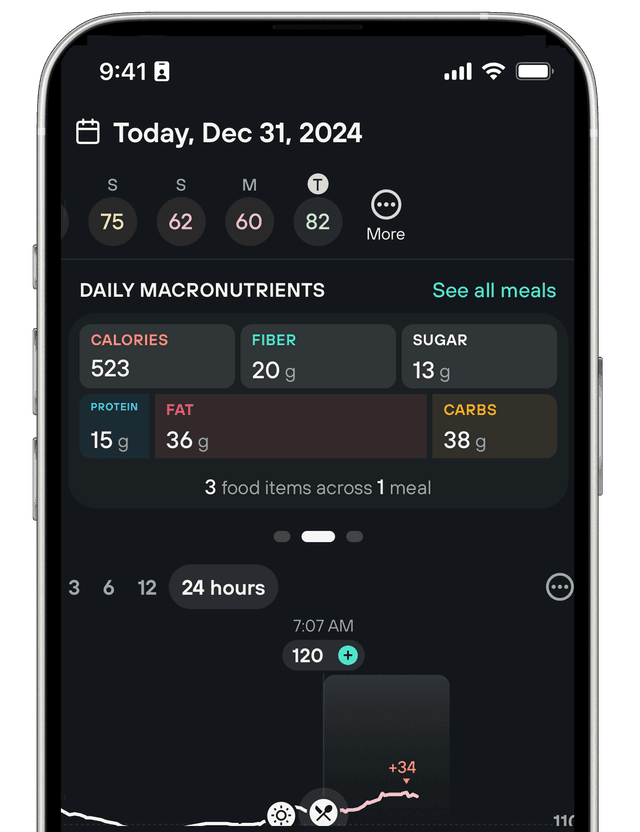
Turn wearable insights into better conversations with your clinician
Levels helps you understand your metabolic baseline with CGM data, comprehensive labs, and personalized guidance — so you can bring clearer questions to your doctor. Click here to learn more about Levels.