5 Things an expert wants you to know about protein and muscle
Dr. Stuart Phillips has spent 30 years studying protein and muscle. His verdict: stop obsessing about protein and hit the gym.

Protein is everywhere—in your snack bars, your cereal, your popcorn. But one of the world's leading researchers on protein metabolism says the marketing craze has outrun the actual science, and the most important factor for building and preserving muscle isn't how much protein you eat—it's whether you're exercising.
Dr. Stuart Phillips is a professor of kinesiology at McMaster University and has spent nearly 30 years studying how protein and exercise interact to shape muscle throughout the lifespan. His findings challenge some of the loudest voices in the protein conversation. In a recent episode of A Whole New Level, Dr. Phillips spoke with Levels Editorial Director Mike Haney about where the current recommendations come from, who actually needs more protein, and why exercise is the ingredient most people are leaving out.
Here are five key insights from that conversation.
1. The RDA was designed to prevent deficiency—not optimize health
The recommended dietary allowance for protein sits at 0.8 grams per kilogram of body weight (roughly 0.35 g per pound)—a number that hasn't changed in decades. Dr. Phillips argues that it shouldn't be the target for anyone trying to support their health, because it was never designed for that purpose.
"There's a big difference between prevention of deficiency and optimization of health outcomes," he says. The RDA was established using nitrogen balance studies—a methodology that treats all protein as interchangeable and identifies only the minimum needed to avoid breakdown. Phillips draws an analogy to vitamin C: the original recommendation was calibrated to prevent scurvy, but research later showed that consuming more than that minimum provided real benefits for immune function and other outcomes. "The same revision hasn't been made for protein, despite—at least in my opinion—that we've got advantages to consuming protein above the RDA."
His recommendation, consistent with a growing body of research: somewhere between 1.2 and 1.6 grams of protein per kilogram of body weight per day (0.5 to 0.7 g per pound). To make that concrete: for a 150-pound person, the RDA works out to about 50 grams a day—roughly one and a half chicken breasts. Phillips' lower bound of 1.2 g/kg brings that to around 80 grams; his upper bound of 1.6 g/kg lands at about 110 grams. The difference between following the RDA and following Phillips' guidance is the difference between one chicken breast and three. That's not splitting hairs—it's a meaningful restructuring of how you eat.
Beyond 1.6 g/kg, he says, it becomes "really hard to show the benefit of more and more protein." There is real individual variation in where someone falls within the 1.2-to-1.6 range—age, activity level, and genetics all play a role—but the range isn't a precise prescription. Phillips' view is that 1.6 g/kg casts a wide enough net to cover the needs of roughly 97 to 98% of people, which means most people don't need to be precise about hitting a specific number, and almost nobody needs to be chasing the 1 gram per pound (2.2 g/kg) figures that circulate in fitness culture.
2. Exercise is the real driver of muscle building—not protein
Perhaps the most important point Dr. Phillips makes—and the one most at odds with how protein is marketed—is that eating more protein, without exercise, does essentially nothing for muscle.
He describes muscle as a brick wall in a state of constant turnover: bricklayers on one side are adding new bricks (muscle protein synthesis), while another crew on the other side is chiseling out worn or damaged ones (muscle protein breakdown). The balance between these two processes determines whether your muscle grows, maintains, or shrinks. Exercise—especially resistance training—is what "gives the bricklayers a kick in the pants" and accelerates synthesis. Protein provides the raw material. But without the stimulus of exercise, there's no drive to put those amino acids to work building new muscle.
"The lifting and the exercise bakes the cake, and the protein ices the cake."
Phillips' lab's meta-analyses make this concrete: protein supplementation alone, without exercise, produces no measurable gains in muscle mass. More protein can help you take full advantage of your training, but the training is doing the primary work—and the ceiling for how much protein actually helps is lower than much of the fitness world suggests. He puts the choice plainly: "If you're stuck on a desert island and you've got tons of protein or you've got an exercise machine—take the exercise machine, every time."
3. Muscle decline starts earlier than most people think—and it's compounded by eating less
Anabolic resistance—the gradual loss of efficiency in turning protein into new muscle—is a hallmark of aging. And it starts earlier than most people expect. "On a population level, we can see detectable changes in muscle in most people at late 30s to early 40s," Phillips says. That's the window when muscle mass typically plateaus and begins its long downward slope.
What makes this worse is that aging tends to coincide with eating less overall—and less protein specifically—at exactly the time when both are needed more. Muscle serves as the body's amino acid reservoir: when dietary protein is insufficient, the body draws on muscle tissue to supply what other critical functions need. That's a manageable short-term buffer, but a poor long-term strategy if you're trying to preserve strength and function as you age.
The pattern Phillips describes is one of compounding disadvantage: older people tend to do less, which accelerates anabolic resistance; they eat less, which reduces the raw material for repair; and underlying physiological processes—oxidative stress, mitochondrial decline, and others—add to the load. "Aging is an inevitability," he says, "but the emphasis on how you age—there's a lot we can do there." The earlier the investment in resistance training and adequate protein intake, the more runway there is before those curves diverge. Phillips' data suggest that habitual physical activity throughout life may be the single most powerful variable in determining how someone's muscle holds up across decades.
4. Protein timing matters much less than the internet suggests
The idea that you need to consume protein within a narrow "anabolic window" after your workout—and that missing it means missing the benefit—is one of the more durable myths in fitness culture. Phillips, who once held a more cautious view on timing himself, now says the window is really more of a garage door.
"Just get your protein within the hours that you're awake, lift your weights, and you're all good to go."
He credits a colleague's research for the reframe: the concept of a tight post-exercise window came largely from studies on carbohydrate and glycogen restoration, and then was applied to protein without strong human data. When those studies were actually done, the window turned out to be enormous—immediately post-workout to as long as 24 hours later. Skipping a post-workout shake while sipping a coffee isn't "losing the advantage," he says. "Maybe if you're those people in Milano-Cortina, the Winter Olympics, and that last little margin—you could argue. But for most near mortals, that is not a big deal at all."
Similarly, the idea that the body can't use more than 20 to 30 grams of protein in a single meal has been walked back by recent data. Phillips says the cap is probably closer to 40 grams, if there is one, and whether protein is spread evenly across meals or concentrated more heavily at certain times of day makes little practical difference for most people.
5. Menopause doesn't cause the dramatic muscle loss many claim
Estrogen decline during menopause has become a popular explanation for muscle loss in midlife women, particularly in influencer-driven health content. Dr. Phillips says the data don't support that narrative.
When you look across the population of women going through the menopausal transition (typically ages 45 to 55), he says, "it's not like there's a big downward deflection in muscle mass." The roughly 8 to 10% decline in muscle seen over that decade is consistent with normal aging in that age group—not a consequence of estrogen loss. "There is no downward bend." Studies giving women menopausal hormone replacement therapy show little to no benefit for muscle retention, though there may be modest strength effects.
What estrogen is critical for is bone—which is why postmenopausal bone loss is a well-documented concern in a way that muscle loss from estrogen decline is not. Phillips does note there may be indirect behavioral mechanisms at play: menopausal symptoms like hot flashes, brain fog, and poor sleep can reduce a woman's capacity and motivation to exercise, which then affects muscle. Hormone therapy that relieves those symptoms may therefore support muscle indirectly—by restoring the ability to train. His bottom line: resistance training remains the most evidence-backed intervention for preserving muscle and bone through and after the menopausal transition.
The bottom line: exercise first, protein second
Dr. Phillips' overarching message isn't anti-protein—it's about getting the hierarchy right. Protein is 100% necessary to build and maintain muscle. But you can't eat your way to lean muscle without the exercise stimulus, and the ceiling for how much protein is actually useful is lower than much of the fitness conversation implies.
Here's the number that puts the whole debate in perspective: "80% to 90% of the benefit the protein provides to you is basically baked in by doing exercise," he says. "The rest is a protein-mediated effect." And when it comes to how much most people are already getting, Phillips largely agrees with colleague and fellow researcher Dr. Christopher Gardner's read of the survey data—that most Americans, particularly men and younger adults, are probably already hitting adequate protein levels. Women and people over 50 are more likely to fall short. The bigger gap for most people isn't protein intake. It's the exercise.
In a marketplace flooded with protein-enhanced everything, his advice stays simple. "Food first should always be the way that you think." Eggs, Greek yogurt, lean meats, legumes, tofu—whole food sources that deliver both the amino acids your muscle needs and the micronutrients that processed protein products don't. And then lift something heavy, consistently, for as long as you can.
This article is based on insights from Dr. Stuart Phillips, professor of kinesiology at McMaster University and one of the world's leading researchers on protein metabolism and muscle physiology.
Why Exercise Is the Secret to Muscle Growth and Longevity | Dr. Stuart Phillips & Mike Haney
In a recent episode of A Whole New Level, Levels editorial director Mike Haney sits down with Dr. Stuart Phillips, professor of kinesiology at McMaster University and one of the world's leading researchers on protein metabolism, muscle physiology, and healthy aging. Phillips has spent nearly three decades studying how protein and exercise interact to build and preserve muscle — and his findings regularly challenge what the internet says you need to do.
The conversation covers where the current protein recommendations come from and why Phillips thinks they're too low, why exercise is far more important than protein intake for building muscle, what happens to muscle as we age, and how to think about the seemingly endless parade of protein-enhanced products on the market.
"The lifting and the exercise bakes the cake, and the protein ices the cake." — Dr. Stuart Phillips
How protein became the hot nutrient — and what that means for research
Mike Haney: Well, Dr. Stuart Phillips, thanks so much for joining us today.
Stuart Phillips: My pleasure. Thanks for having me on the show, Mike.
Mike Haney: So, before we dive into everything we're going to talk about, I'm just sort of curious — because you've been studying protein for 25 years plus. What's it like as a researcher when your field of research becomes the kind of hot, buzzy thing as it has the last couple of years? I would imagine it's a double-edged sword. Like maybe on one hand it's easier to get research funding, but on the other hand there's probably a lot more misinformation and every influencer now has an opinion about the thing you've been studying.
Stuart Phillips: You're spot-on, actually. I mean, it's great. I started being at McMaster now for 28 years, and so been doing probably protein for a little bit longer. But when I first got into this and I was going to conferences, it was all about — particularly for athletics and sport performance — it was all carbohydrates. And then we went through a phase where it was all about fats. And now finally protein's in the spotlight. So, great that it's here. Awesome to get all the attention.
But as you said, there is a double-edged sword. I mean, the number of protein-containing products has skyrocketed. It's everybody's favorite nutrient. And social media has just exploded and the claims that are made around protein now are — well, some of them, let's just say a little bit wild.
And who doesn't like the attention, right? I don't know about research funding. That's — I'm waiting for that to roll in, but we've done okay with protein-related research, for sure.
The numbers: what the RDA gets wrong and what the research actually says
Mike Haney: Well, that's a good lead into where I want to start, which is with the numbers, because I think that's when you talk about protein, this is the takeaway if folks aren't going to watch the whole episode — what they want to hear is what does the expert say I actually need. And I know you've been pretty consistent, I think, for a good number of years now about the values you think are appropriate. Then I want to dig into all the sort of nuance around it. But let's just maybe start there with the RDA and what you recommend and what maybe some of the upper end of what often gets recommended.
Stuart Phillips: I think that somebody told me one time that "how much protein do I need" is one of the most entered questions on Google with respect to sport and supplements and everything. So, the RDA — or recommended dietary allowance — which hasn't changed, just for the record. There's some new dietary guidance and we can dig into that, but sits at 0.8 g of protein per kilogram of body weight. Now, I know you got a US audience, so translating that, it's 0.35 g of protein per pound of body weight. And myself and probably about a half a dozen other researchers have been of the opinion that that's too low.
It's established using an old methodology. I don't think it's overly appropriate to use it in current context. So, I would say that it should be closer to about at least 0.5 g per pound, and probably closer to about 0.7 g per pound. Beyond about 0.7, I think it gets really hard to show the benefit of more and more protein.
So, that scales up at a per kilogram body weight somewhere between 1.2 to 1.6 g per kilogram of body weight.
Mike Haney: Yeah, and I always like to put this in a little bit of kind of real-world context for people, because one of the things I found when I talk about this is when you start talking about 1.2 versus 1.6 or 0.3 versus 0.5, it sounds like we're really splitting hairs. But when you actually put that into real numbers — if you're a 150-lb person, the RDA would be about 50 g a day, 50 to 60. Your Attia's of the world would be telling you to take in 150 g, and you're probably somewhere in the middle at 100.
And if a chicken breast is 30, we're talking about do you want to eat one chicken breast a day or five? Like there's a big difference in how you structure your diet depending on which of these guidances you follow. So, maybe we'll just start at kind of that bottom end. Why do you feel that the 0.8 is not enough? And maybe this is a good place to just explain what nitrogen balance is and why you think it's not really the best methodology anymore for this.
Stuart Phillips: Yeah. So, the balance of nitrogen — in versus out — is considered a hallmark of protein, mainly because protein is the only source of nitrogen that we have, or the main source of nitrogen that we have in our diet.
So, if you measure how much is going in in the diet and how much is coming out in urine — these are great studies to do because you've got to collect fecal samples and everything else like this. I think I might be one of the last people in terms of the literature to ever in recent memory conduct the full nitrogen balance in athletes, where we did sweat wash downs, we collected fecal samples, we collected urine and everything. They're wonderful. Let's just say I've got grad students to do that stuff now, but I wouldn't make them do that.
But it treats every amino acid — which are the building blocks of protein — as the same. It essentially equates all protein as just nitrogen. And there's no nuance for understanding specific roles of certain amino acids.
And what it defines is a minimum. And to that minimum, there's a safety margin added, and it's really about prevention of deficiency — that would be the right way to describe how the method is used. You know, there's a big difference between prevention of deficiency and optimization of health outcomes. And the analogy that I think people can understand much quicker is to say that we used to say that the requirement for vitamin C was enough to prevent scurvy.
And that's awesome. Who wants to get scurvy, right? But then we recognized that eating more than the basal requirement to prevent scurvy actually was good for you. It was good for your immune function. If you were a smoker, you needed more. All of these things. So, we revised the estimates for vitamin C in the upward direction.
But the same revision hasn't been made for protein, despite — at least in my opinion and several others — that we've got advantages to consuming protein at above the RDA. So, 1.2 g per kilo, or as you said, 0.5 g per pound, doesn't seem like a lot, but that's 50% higher than prevention of deficiency levels. Similarly, at 1.6, that's 100% higher than the prevention of deficiency levels. So, the two situations are quite different.
What happens when you don't get enough protein
Mike Haney: So, if I'm somebody who's getting even less than the 0.8 — if we trust that 0.8 is roughly around kind of the preventing deficiency — if I'm for whatever reason getting 0.2, if I'm taking in 15 g of protein a day because I'm living off, as I did in college, Lucky Charms and Ho Hos. What's happening in my body? I'm clearly not building a lot — well, we're going to talk more about muscle protein synthesis versus muscle breakdown, and I know those processes are always ongoing in some kind of balance. But what's happening within the muscle if I'm getting below that deficiency amount?
Stuart Phillips: Yeah, you know, protein is a substrate unlike carbohydrates and fats, which, when you boil it right down, they've got other biological roles, but they're essentially fuel. We burn them.
Protein forms all the structural components in our body. The one that everybody goes, "Oh, it's muscle." And I'm like, "It is, but it's also skin. It's also 40% of your bone mass — that's actually protein, it's collagen protein. So is our heart, so is our brain, so is our liver. I mean, those are all just big conglomerations of cells that are a big mass of protein when you look at it."
And so, from that standpoint, you'd appreciate that if you weren't getting enough, you would begin to break down some sort of structural component in your body to give your body the amino acids — these are the building blocks of protein — that it needs. And the easiest one to break down and the sort of labile pool is muscle. So, people who are consuming low protein intakes — and a patient scenario is an easy one to understand: you're in bed, you're not eating much, you're sick, or maybe you're unconscious, or you're being fed through a tube — we can't give people enough protein in that situation and they give up muscle to provide the amino acids that the body looks at as more important processes than muscle. So you will lose muscle mass. And if you're in bed for long enough, or if you're consuming Lucky Charms for your diet, you would be giving up muscle mass over a period of time.
Mike Haney: I've heard you say that, unlike carbs and fat, the body can't really store protein. But in some ways the muscle is sort of a storage depot for it, in the sense that it is a place the body can pull from if necessary — but under different circumstances than, say, when we liberate carbs or fat to use as fuel.
Stuart Phillips: Yeah, no, exactly. I mean, I think it's a fair comparison to say muscle is a storage pool. But if you're into performance or you're into aging well, then your muscle is also a functional reserve. And I think a lot of clinicians who deal with patients in the intensive care unit, for example, know full well that once you begin to tap deep into that functional reserve, a patient's chances of survival go down and down.
And so your ability to resist disease or something like that is really a direct function of how much muscle mass you have. So it is a labile pool. You can mobilize it when your body needs to, but you're essentially tapping into eventually a functional reserve that gets down to such a low level that your chances of survival of whatever insult you have are pretty low.
Individual variation: who needs the high end of the range?
Mike Haney: So, let's talk then about this kind of recommended mid-range, the 1.2 to 1.6. How much individuality is there in that number? In other words, what does the scatter plot look like when you do your studies? Is it the case that some people have as much sort of positive balance of protein synthesis versus muscle breakdown on 0.8, and other people do really well on 2.0, and we just kind of average around 1.6? Or is the 1.6 number — because I know you've done a ton of research into this — is that a representation of some sort of physiological process, where that's just the way amino acids and muscle tissue work? That's the upper limit at which, beyond that, your meta-analyses have basically shown you're not getting at least efficient muscle building anymore. But is there a lot of individuality within that number?
Stuart Phillips: Yeah. Whenever we get these recommendations — and there's a range in 1.2 to 1.6, obviously, and it's not a trivial range. If you average it out, it's probably for most people a difference of maybe about 40 to 50 g of protein a day, and that's not a small amount. That's, chicken breast wise, a chicken breast and a half, so to speak.
I think in all of these things, we like to give a range or we stick to one value, but there's always variation about the mean. One of the things that is pretty clear is the distribution does have a longer tail. So, people sort of tail towards the higher end of the recommendation — that would be towards the 1.6.
But I'd say that at 1.2 you're probably covering about 80-odd percent of the population. And to make it clear, it's not that I have a problem with people going as high as 1.6. But after that — and you mentioned are there people out around sort of 2 g per kilo — there are, in certain situations. Like a weight loss scenario, because everybody is familiar with when you're losing weight, you're losing fat, but you're also giving up some lean mass, some of which is muscle. So for those people, they would have protein requirements closer to the 2. But in the normal, non-weight loss situation, 1.6 is sort of the narrow end of the range. And capping it at the highest end of the range, that would be 1.6, which would cover the needs of 97-98% of people out there.
Mike Haney: And is that variation a function of individuality — meaning genetics, microbiome, epigenetics, etc. — or is it a function of other things like age, gender, activity level, or a little bit of both?
Stuart Phillips: Yeah, I mean, everything's in there. Your baked-in genes, so your mom and dad, your epigenetics — or the ability of you to influence what mom and dad gave you — your environment, sex probably not much. I think between males and females we're pretty clear now that it's more similar than it is different for sure. Age — I've been a long-term advocate of protein intakes for older people. And everybody goes, "When does aging start?" And I'm like, "Well, it's my age plus one. So, this year it's 59." But kidding aside, on a population level we can see detectable changes in muscle in most people at late 30s to early 40s. So if you think about that — that's the time in which your muscle sort of plateaus and begins to tail off — that would be when I would say, you know what, you need to start thinking about consuming a little bit more protein, which is the opposite of what most people do with aging, which is actually they consume less food and less protein.
But I do think that exercise as a stressor is going to push you obviously towards the higher end. And there's a lot of people out there who are talking about the mythical bodybuilder range of 1 g per pound or 2.2 g per kilo. It's not that I have a problem with those types of intakes — in fact, we've probably been guilty of saying it might be that high in some of our papers. I'm just not convinced it's necessary to get up to there. I think it might be safe, but the benefits really tail off after about 1.6.
Exercise is the real driver: understanding muscle protein synthesis
Mike Haney: Well, that's exactly where I wanted to go next, kind of digging into that big meta-analysis you guys did about five or six years ago. Just to put it in real-world terms — if we take as a baseline that everybody should be doing some level of resistance training, what's the difference, not necessarily in needs but in what my body is doing with that protein, between somebody doing two bodyweight workouts, 20 minutes at home, versus the gym bro who's doing CrossFit four times a week? If they're both taking in 1.6 g per kilogram, what's happening differently in their body, and is one of those sufficient and the other not?
Stuart Phillips: Yeah, so I think the answer to the question requires a little bit of explanation. You've used the terms already — muscle protein synthesis and breakdown. So the analogy I use when I'm teaching this to undergrads is to say: imagine that your muscle — the tissue that we care about — is like a brick wall. On one end of the wall we're putting new bricks in. Those are the new amino acids going to make new wall. But at the other end there's another crew that's saying, "This brick's kind of damaged — we're going to chisel that one out." So there's constant what we call turnover. Bricks going in — that's muscle protein synthesis, we're making new muscle proteins. Bricks coming out — that's muscle protein breakdown. And obviously, more bricks going in than out, the wall gets bigger. More bricks going out than in, the wall gets smaller.
But usually what's happening is those two processes are bouncing back and forth throughout the day depending on when you eat. And this is a big driver, and I think it's a really important point: when you exercise, particularly when you lift weights, what you do is give the bricklayers a kick in the pants and they just start accelerating the rate at which new bricks go into the wall.
So from that perspective, somebody who's just sitting around — 1.2 is more than enough. You're satisfying the brick builders, the wall's staying in good shape. But as soon as you introduce exercise as a stressor — even a couple of bodyweight workouts — you're driving that synthesis side of things. You eat some protein, more of that protein gets funneled into that process in muscle. Then you go from somebody doing three pretty serious workouts, they're accelerating the synthesis side of the equation even more. And then you get into somebody who's doing CrossFit — they're doing a lot of work, lifting as well, but they're burning amino acids because they're doing some aerobic work. And the muscle prefers to burn carbohydrates and fats, but it will burn protein. Runners even have increased protein requirements simply because they tend to break down and burn protein for fuel.
So the muscle plays a central role — the more you use it — in determining what the fate of the protein you ingest is. All the other tissues, unless you're growing. When you're a kid, you need protein to make bones bigger, your brain's getting bigger, your heart's getting bigger, but after you're done growing, it's pretty much all about muscle, and then hopefully to a certain point at which you're trying to slow that downward trajectory. So everybody goes, "What are you training for?" And I'm training not to age poorly, training to age well and try to just change the slope of that downward trajectory somewhat.
"The lifting and the exercise bakes the cake, and the protein ices the cake." — Dr. Stuart Phillips
Mike Haney: I think we've all heard the idea that when you lift weights, do resistance training, you're essentially breaking down your muscle so that it can be built up more strongly. So, is that true, and is there a relationship then — if I'm somebody who is doing a lot of lifting, am I actually increasing that muscle breakdown side, and is that what stimulates the bricklayers on the synthesis side to put more in?
Stuart Phillips: There's a partial truth to that. When you lift weights, you stimulate not just the synthesis side, but you also stimulate the breakdown. So you accelerate the rate of turnover. And in and of itself that's not a bad thing — it's as if the wall, over time, if you just let it sit there, it begins to break down, some of the cement comes out. But with the crew working, that allows for efficient maintenance and upkeep of the wall. It's like somebody's pulling up the hood and stripping down your car and building up the engine again every night. It's like a Formula 1 race car — it gets broken down and put back together for every race and then shipped to wherever the next race is.
The truth is the science of "you're lifting weights and that's causing muscle breakdown and so we're repairing the breakdown" is partially true. But it's really about just driving the synthetic side, and then the breakdown side just has to kind of come up to keep up and remodel the proteins rather than just create net accretion.
And the other point I make here is that — we all know this — we say it's muscle, and it is, of course. But running throughout the muscle is this lattice of collagen. And then at the end, the lattice tapers down to become a tendon, and the tendon then goes from the muscle and attaches to the bone. If we could figure out a way to more effectively repair connective tissue as we all get a little bit older, I wouldn't be talking to you from Hamilton, Ontario — I'd be talking to you from a beach. Connective tissue remodels as well. That probably gets damaged and broken down and we're just not very good at making new connective tissue, particularly as we get older.
So there's a sort of basal level: there's just, even if I'm not an exerciser, even if I don't ever think about protein, my muscles are turning over every day. It's just happening.
Mike Haney: You had some interesting stat around the idea of every so many days or months you essentially have all new muscles.
Stuart Phillips: Yeah, I'm smiling because I have a good friend and colleague named Luke Fenlon, and he's Dutch. He always has this thing — he says, "Look at your arm, and if you look at your muscles, in 55 days you'd have a new muscle." I'm probably doing a really poor imitation of his accent, but he's an amazing researcher. But it's true. You've effectively replaced all of the protein in your muscle — probably closer to about 80 days, but it's brand new. If you did the same thing with your gut, looking at all the cells in your intestine, for example, it's almost brand new inside of a couple of weeks. That's how fast we're turning over proteins in those tissues.
Mike Haney: Yeah, and I feel like we've kind of heard that fun fact about other parts of the body and your cells that get turned over, but I hadn't really thought about it on the muscle side, outside of that proactive weight-lifting, with this idea that you're breaking it down and replacing it. But so there's a basal level that's happening sort of no matter what. And you've talked about protein as a sort of substrate and exercise as really the stimulus. So when we think about what's going to goose that process — if I'm not being active but I'm taking 150 g of protein a day, I'm not going to suddenly start growing muscle.
Stuart Phillips: Yeah, and this is the point — we've done a couple of these big meta-analyses now and we've looked at the data where people intervene with more protein — just give people more protein — and it does nothing for muscle. It does nothing probably for any other tissue. Your body doesn't, when it gets more protein — it's not like it goes, "We're going to stock this away." There's not a place to put it. And if there's no drive to the muscle to put new amino acids in, make new bricks, make a better wall — and the wall's not turning over faster — then you're not going to gain more muscle simply by eating protein.
And that's — the recent revision of the US dietary guidelines and the protein range from 1.2 to 1.6 — my point is that should have come with: you need to be exercising and specifically doing some weight lifting to take full advantage of that range. The analogy I've used — and Luke makes fun of me for this one — is that the lifting and the exercise bakes the cake, and the protein ices the cake. And I think that's probably an appropriate way of thinking about things.
Mike Haney: Yeah, so one of the things I think you've been really consistent on is that maybe instead of obsessing about how much protein you're taking in, make sure you are exercising first. Because if you're lifting weights regularly but you're only getting sort of 50 g of protein a day, you're still getting some benefit. You're maybe not getting the maximum benefit that you might if you take in, say, 100 g, depending on your weight. But the opposite is not true — that if I am not exercising at all but I go from 50 g to 100 g of protein, I'm not really getting any effect there.
Stuart Phillips: No, perfectly stated. If somebody goes, "You're stuck on a desert island and you've got tons of protein or you've got an exercise machine" — take the exercise machine, every time. It's going to do a whole lot more for you. You might be missing out on a little bit of the gain because you didn't have the right protein, but you're going to be helping your muscle retain protein and you're going to be doing a ton of other good stuff for your health otherwise that the protein will never do.
I don't know how many interviews I've done since the new recommendations for the guidelines came out, but everybody goes, "So, tell me your takeaway." And I said, "Well, in the absence of exercise, these new recommendations will not change anything so far as any chronic disease out there. It's not going to budge the needle." The exercise is the big driver. The protein — all good, don't get me wrong. But without exercise, you're not going to use it for sure. You're definitely not going to gain muscle.
"In the absence of exercise, these new recommendations will not change anything so far as any chronic disease out there. It's not going to budge the needle." — Dr. Stuart Phillips
Protein, insulin resistance, and metabolic state
Mike Haney: So, one more thing on just the variability side of this. We focus a lot here on metabolic health, and I cover a lot of glucose, insulin, that kind of thing. So, I'm just curious if metabolic state is also a factor in this — insulin being an anabolic hormone. And I know you've looked at this as well, but what's the relationship between, say, my state of insulin resistance and my response to protein?
Stuart Phillips: Yeah, I mean, they're probably related. Resistance to insulin as it's classically defined — and your listeners would know this — it's resistance to carbohydrate in terms of uptake into insulin-sensitive tissues, muscle being one of the big sites, and adipose tissue and a few others being the remaining sites.
There's probably a parallel analogy with respect to amino acid uptake into muscle and other tissues as well. So if you're insulin resistant, you are resistant to the effects of elevated amino acids in your blood after a protein meal. So I think they share some similar biochemistry.
It's not completely analogous, though. There is a phenomenon that comes with disuse or bed rest — and aging, of which relative disuse could be a part, or inactivity — that the muscle becomes resistant to amino acids very quickly. And insulin resistance sets in just as quick. So the parallel is worth noting for sure.
Aging and anabolic resistance: why the muscle-building process slows down
Mike Haney: Well, that's a good lead into aging. And I know this is where you've also done a lot of work with your lab — working with a lot of older folks and trying to help people sort of preserve function. So, let's just start there. Why is it that we get anabolic resistance — that sort of less efficient muscle building as we age? Do we know the sort of evolutionary mechanism behind that?
Stuart Phillips: So, the last check — I don't work in aging per se, but my read of mechanisms for aging — there's probably about 12 or 13 or so proposed reasons why cells age and then, we're basically a collection of cells, why we age as well. And all of those could be breaking down as we get older and contributing to this kind of anabolic resistance.
At the same time, inactivity happens. And everybody goes, "Oh, but I go to the gym." And I'm fond of pointing out that from humans all the way down to earthworms, as we get older, we do less. There are obviously notable exceptions — there are some folks my age doing crazy amounts of activity. But on average, people do less. Dogs, cats — if you have them — they do less. They sit around more. They're less reluctant to go for a walk. They just don't have the same vigor as when they were younger. It's exactly the same in people.
I think that's one of the big contributors to this age-related anabolic resistance to amino acids, and probably insulin resistance. Every now and again we run trials in older people all the time, and we advertise for people who are relatively healthy. Rarely do you get one, but every now and again we get somebody in their 70s who walks in and we say, "First question — what medications are you taking?" And they say, "None." And it's like — the phone rings, it's like, "We've got one down here." It's a unicorn.
And then you say, "So what do you do?" And it's like, "Oh well, I run down at the club and I've got four dogs." And you give them a pedometer and they're taking 23,000 steps a day. And metabolically, their muscle looks like — I don't want to pick on any individual faculty, but I'll say a med student during their residency — so I am picking on a faculty, I guess. Because they're not getting sleep, they're not getting a chance to exercise, and they're usually in their late 20s, early 30s. Those individuals metabolically don't look too dissimilar from each other.
So there's hope yet if you're getting older. But the amount you have to do to sort of maintain that efficiency as you get older — the ramp goes up pretty steeply. And at a certain point, aging wins, right? No matter how much activity you do, all those other mechanisms are just saying: cells breaking apart, not the same integrity. And that's probably contributing to this as well.
Mike Haney: And I would imagine — you mentioned earlier the fact that we do just tend to take in less food, and therefore probably less protein. Dietary patterns just sort of change. So there's a little bit of just sort of natural lifestyle stuff that tends to happen, and then also a kind of physiological process in which our body is just simply getting less efficient at turning those amino acids into — our bricklayers are getting tired.
Stuart Phillips: They're aging, too. Yeah. Is there an equivalent increase in catabolism? Are we breaking down muscles faster than we used to?
Probably we are. There's a phenomenon — oxidative stress is the one that probably a lot of people have heard about. We know with aging that the amount of oxidative stress we're experiencing goes up. Our genes tend to get smaller because our chromosomes get shorter. There are enzymes that kind of chew at the end of our chromosomes and they get shorter. There are other processes to do with energetics within the cell — around, if you read Peter Attia's book, Outlive — the mitochondria. All of these things begin to — when you draw a picture, it's like, "This is the house the way it looked when it was built, and here's the house 100 years later." It's starting to show signs of wear and tear no matter how good your crew on the outside is, trying to repair and do everything. Because everything tends towards entropy. It goes from order to disorder, and that's simply a process of aging.
And so, probably lots of things are happening that we just can't defend against. Aging is an inevitability, but the emphasis on how you age — there's a lot we can do there, obviously.
Starting early: how to build the best foundation for aging well
Mike Haney: Yeah. What kinds of things can we do, and maybe starting — how early can we be doing things that are going to help us age as well as possible? My dad's in his mid-80s, but he was a factory worker all his life and so just very active, and he's in great shape for 85. And I'm convinced it's because he's in Minnesota where it's cold and I think that's a good stressor. And he's just been active all his life, without paying a lot of attention to the specifics of weightlifting or protein or anything like that.
So, is there anything to that sort of early start? And how early — if I start working out in my 30s versus my 40s versus my 50s and building that muscle or making sure I'm getting adequate protein — how much can I push back against those natural forces?
Stuart Phillips: Yeah, I mean, I think the answer is that probably the earlier you make the investment — in quotation marks — it pays off. It's sort of compound interest in terms of, the graphs we usually draw: you grow as a kid and then you get to sort of this level in terms of, say, muscle mass, and then in your 30s, 40s, you begin to decline.
I think you can delay that, probably into your late 40s, early 50s. And then inevitably there's this downward slope. And I suppose the easy way to say it is that the more activity you have — and to your point, everybody goes "Exercise." And I'm like, "Yeah, exercise. But if you're just habitually physically active, if it's part of your occupation" — if you go back 50 years, we were a lot more physically active as a group around the world because we just did a lot more things. We didn't have machines to help us and we didn't sit in front of a screen all day.
So the bottom line is: you could have a downward slope that goes like this, or you could have a downward slope that goes like this. The loss of muscle, the loss of function, the loss of mobility — could all be contributing to a poor pattern in aging. But you want to hit that sort of peak muscle mass, peak bone mass. What we do know is the higher you start — and similarly if the trajectory is downward and you're like this versus like that, those curves begin to diverge the older you are.
The theory is that you cross some sort of threshold and you can't do something in your life. And at that point, your mobility goes down, your world becomes smaller, you don't do as much, and then it becomes a bit of a spiral. And baked into all of that equation is — have a good circle of friends, eat well, sleep well, and all these other things as well.
But when I give people a hierarchy of things that you can do for yourself to change that trajectory — to age better — physical activity, exercise, is top of the heap. And as you point out, there are some extraordinarily, probably genetically gifted people who take full advantage of their ability to do things. Like your dad — didn't have to probably go to the gym, didn't really have to — but got up, was physically active. If he's living in Minnesota, he gets honorary Canadian status. He put up with winters as bad as ours up there. They even speak like Canadians. They just don't say "eh" at the end.
And you know, it's an interesting observation — people who do these physically active jobs, they tend to have decent health as long as they don't have the poor lifestyle stuff associated with it. So you don't require exercise per se, but physical activity is key and core.
Mike Haney: [laughter] Yeah, and I think that, I've heard you talk about this as well — that that may be partially what explains some of the blue zone stuff, is that the people in the quote-unquote blue zones, to the extent we buy that as a concept, tend to live in hilly areas where they're just walking up hills a lot more.
Stuart Phillips: Yeah, like — I was talking about this with my group the other day, and we were talking about blue zones, and everybody goes, "Yeah, yeah, yeah." And we named all of them — Loma Linda, California, Costa Rica, Sardinia, Okinawa. And I'm like, "Have you seen pictures of those places?" And they're like, "Yeah." And I'm like, "I don't know — I'd like to live to 90 if I lived in those places, too." To your point, it's almost like a huge hill down to the water, and people walk up and down it. It's not like everybody goes to the local gym and lifts every day, but they are tremendously physically active and have been so for a large portion of their lives.
So I think that, as much as you buy into the blue zone concept — and yeah, it's been dismantled a little bit recently — the ethos of the message is that these people are very physically active, for sure.
Hormones, menopause, and muscle: separating fact from influencer claims
Mike Haney: You mentioned menopause a minute ago, and I want to kind of dig into the hormone side because I think this comes out in two different ways. On the male side, there is the natural drop in testosterone — take that all the way out, people taking replacement testosterone to either get healthy again or to build lots of muscle. On the female side, I think there's a belief that the drop in estrogen that comes with the menopause transition is partially what contributes to muscle loss. And I've heard you say that doesn't really bear out in the literature. And that taking extra testosterone is not really bearing out in terms of making you not just build more muscle but sort of use protein more efficiently. So maybe talk about what are the roles of those two hormones in terms of the aging effect in muscle maintenance.
Stuart Phillips: Yeah. A lot to unpack there, but I'll just sort of start out by saying that if we ranked hormones with respect to what we call their androgenicity — androgenic hormones are hormones that are anabolic for muscle — right at the top of the heap would obviously be testosterone. When we look and compare the two main female hormones, because females have tenfold less testosterone than men, they've got estrogen and progesterone. Progesterone is folds lower, but it's actually a little more anabolic than estrogen. Estrogen is lower down for muscle. Now, everybody goes, "What about bone?" And estrogen is super good for bone. But not as much for muscle.
My point has been — and it upsets a lot of people who have a different interpretation, but mine's based on data — when you look across a population of women, 95% of whom will go through menopause between the ages of basically 45 and 55, so 55-plus they're postmenopausal — it's not like there's a big downward deflection in muscle mass. There is in bone mass, because estrogen is remarkably potent anabolically for bone. Men don't have that precipitous drop because with age, their testosterone declines gradually, generally.
And as you point out, you can get a level of testosterone that puts you in what we call the hypogonadal range, and then clinically you could take testosterone replacement therapy. The more vogue thing now is, "Well, I'm just going to keep myself up to this level, because I feel good when I do it. Generally my libido is better when I'm taking testosterone replacement therapy." But if you're lifting weights, then you can take advantage of that higher testosterone and retain a little bit more muscle.
What we don't find is when we give women menopausal hormone replacement therapy, that they retain more muscle. They might retain a little bit more strength. And the indirect mechanism — and this has been brought up to me by several women, including my wife — is that menopausal hormone therapy takes away a lot of the symptoms that remove a woman's agency to be able to think about doing exercise, instead of having brain fog and hot flashes and poor sleep and everything. So I buy that as a secondary hormonal mechanism. It's more of a behavioral one.
But I don't think there's good data to show that the loss of estrogen during the menopausal transition is associated with some sort of precipitous decline. And I've heard influencers say, "Oh, you lose, you know, three, four times as much." And I'm like, "Well, 45 to 55 is 10 years of normal aging. So in a decade of aging, we would expect around an 8 to 10% loss in muscle in that phase of life. And that's exactly what we see. There is no downward bend."
There is data to show that women do lose a little bit of strength in there. So there could be some neuromuscular consequences to the decline in estrogen. And if you want another reason why you should be lifting weights — first, it's great for bone. Second, that menopausal transition — watching my wife go through it, it's hell on wheels from the outside. And maybe resistance exercise is something that pushes back against a lot of these adverse metabolic but particularly musculoskeletal issues that a lot of women suffer from.
Protein and kidney health: a 60-year-old hypothesis that still lacks proof
Mike Haney: I just want to touch briefly on — we've been talking a lot about protein in its relationship to muscle, but you mentioned early on that protein does a lot of other things in the body. Maybe talk about the relationship between protein and kidneys, because I think this is the other thing that people might hear a lot about in the world. We had a nephrologist on a while ago, and he didn't go as far as saying protein is poison for your kidneys, but I think his point of view is: if you're somebody who has chronic kidney damage, if you're leaking towards kidney disease, you might want to be careful. So what's the relationship between kidneys and protein intake?
Stuart Phillips: Yeah. Probably about 60 years ago, a guy named Barry Brenner, who is a nephrologist, did a lot of work — mostly in animal models — showing that protein, the more you ate of it, creates urea, which is the substrate that mammals produce to excrete excess nitrogen from protein. And the theory was that the more protein you consumed, the more urea you produced, and that effectively over time kind of wore the kidney out. And the kidney began to have trouble filtering the substrates that it usually filters, urea being one of the primary ones. So protein was a causative agent in the progression of kidney disease and then eventually leading to kidney failure.
We're 60 years past that hypothesis, and there's been lots of research done in humans and in animals. From a protein intervention standpoint, high protein as you age being causative for kidney failure — there's no evidence that that's the case. Observationally, I think the evidence would be best summarized as mixed, leaning towards null. We can't find it.
So my takeaway is that we're 60 years post hypothesis, and we still don't have the data. The common pushback is, "Well, absence of evidence isn't evidence of absence." And I'm like, "True, but it's been 60 years." And it's not like cigarettes and cancer — we got that one. It took a while, right? And tobacco companies pushed back hard. But there's no one out there on big protein trying to block publication of trials indicating a causative role.
So I'm of the opinion that — and the nephrologist you've had on may disagree — when you go to dialysis clinics, the vast majority of the folks there, not everybody, but a lot of them have type 2 diabetes, they definitely have hypertension, and those would be higher on my list as causative issues for kidney failure than a lifetime of habitually higher protein intake.
But to the point you made and that the nephrologist guest made — if you have poor kidney function, then a higher protein diet is probably not a recommended thing for you, because you're just making more urea that the kidney has to filter, and we know its function is reduced.
What I'm going to say — and this is absolutely true — is that if you're somebody with poor kidney function, one of the best things you can do is to be physically active. And particularly to be resistance training. Because kidney failure patients lose muscle like crazy because they're on a low protein diet — which is preserving kidney function — and they're remarkably inactive. But we've got trial data now showing that the retention of muscle in these folks is drastically improved if they lift weights. So we come back to the same message again.
Practical takeaways: are most people already getting enough protein?
Mike Haney: All right. Well, let's end with some kind of practical takeaways around this. And maybe I'll start here: we had your friend Chris Gardner on the show, and one of Dr. Gardner's points around protein that stuck with me was: if we look at the survey data, most people are getting 1.2 to 1.6 g already. And so, is all of this moot?
I'll say, from my role as an educator and a journalist, the message I've been pushing the past few years is: you should probably be taking in a little bit more than you are, you should probably pay more attention to it. And now I'm starting to question whether or not that's true, because there's only so many things people can focus on. Should we just take protein more or less off the table and say, "Put your energy instead towards less sugar, more fiber or other things"? How much do you buy that we're all getting enough already?
Stuart Phillips: I'm smiling because Christopher's a good friend. We always have a spirited conversation when we get together. Lots of respect for Christopher — he's a really accomplished scientist in his own right.
One of the things I always say — and he uses the NHANES data, basically a large scale US survey, to point out that most people are getting enough — I think he's probably right when you're talking about men. I think men consume more protein on a per kilogram body weight basis than do women. And I think he's probably right in most cases — if "most" is 50% plus one — for people under the age of 50. Once you get a little bit older, and if you're female, I think the "most" part begins to become an issue.
But as I said before, simply consuming more protein is probably not going to help. The exercise part definitely helps. For a lot of people — particularly young, university-age males, we have about 16,000 of them on campus here — no, it's probably not an issue. For a lot of the females on campus, it could be. Particularly with food restriction. We've got a generation of Canadians and Americans now taking GLP-1s — basically massively reduced appetite — it could be an issue.
But I said to Chris one time — and I think I shocked him a little bit with this: 80% to 90% of the benefit the protein provides to you is basically baked in by doing exercise. The rest is a protein-mediated effect. He was like, "Hold on." He goes, "I got to record that." And we sort of went on from there.
"80% to 90% of the benefit the protein provides to you is basically baked in by doing exercise. The rest is a protein-mediated effect." — Dr. Stuart Phillips
Christopher's argument about needing to focus more on dietary fiber — I would never disagree. My point would be that I don't think the two are mutually exclusive. It's not like we can't have a higher protein intake focusing on nutrient-dense foods — Greek style yogurt, eggs, lean meats, even plant-based proteins, tofu, legumes — and get more fiber at the same time.
25 years ago, Stu Phillips would have told you something different, but everything that we've studied since with plant proteins compared to animal proteins suggests that the difference is much, much smaller than the score difference would indicate, which looks impressive and the average punter on Instagram can cite like that. I don't think our goals are too different. Christopher has obviously his line of argument and reasoning. He's much more plant-focused, and he's a plant-focused guy in terms of what he eats as well. I'm a died-in-the-wool omnivore, so maybe that colors our perception of the problem.
But he has a point, and I would agree in large part with what he says. It's not an issue so prevalent that we need protein water, protein Pop-Tarts, protein cereal, and another freaking protein bar. Like, I don't know how many there are — 200? And then somebody goes, "We're coming out with a new protein bar." I'm like, seriously? That's about as unoriginal as it gets — it's just capitalizing on everybody's obsession with protein right now.
So Christopher's right: our obsession with protein has sort of gone over the top. But I don't think it's mutually exclusive — you can get it all through real food, and I think Christopher would agree with that.
Mike Haney: Yeah, I mean, that's where all the conversations that we have kind of come back to — eat real food. [laughter]
Stuart Phillips: And I think it isn't — and so, protein bars, I just want everybody to think about — they go, "Oh, I take this protein bar." There's the massive — to use a great Yiddish word, gamish, I don't know what it is — of ingredients that is the living definition of ultra-processed. So you pick them. I just choose real food first.
Mike Haney: So, just to further on this sort of crazy world we live in with all these protein-enhanced products — I take the point that a protein Pop-Tart, which I think is hilarious that such a thing exists — the addition of protein is not making that Pop-Tart good for you. If I take something like protein popcorn, and popcorn's not the worst thing as far as processed foods — if I'm going to buy a bag of popcorn anyway, is there anything wrong with getting an extra 10 g of protein via a protein popcorn? Or, to go all the way out, let's just say a healthy, well-formulated protein supplement. Is there any additional benefit to the food matrix to taking that protein in through an egg, through a legume, through a piece of meat, as opposed to a powder or something sprinkled on my popcorn?
Stuart Phillips: Yeah, that's a great question, and I think it sort of hones in on the emphasis on whole food and real food. When I talk to athletes here and we teach usually young men to shop, we say: shop around the outside of the grocery store and avoid the aisles right in there. You do the average grocery cart and it's produce, meats, dairy, and then grains down the other side. I think that's a good way to sort of unpack that whole foods probably have a lot of things going for them.
You need calcium, you need vitamin D, you need potassium, you need all the B vitamins. You get those from whole foods. So I think there's probably something in the food matrix, and we've made a lot of mistakes nutritionally focusing on individual nutrients as being the reason why diets high in fruits and vegetables were good. Like lycopene for prostate cancer, because men who ate more tomatoes have more lycopene. And then you do the trials and lo and behold, it does nothing. So maybe there's something special about the tomato in the food matrix — the food is just better than the isolated nutrient.
Now, protein powders fall in a slightly different category only because they're the isolated nutrient away from anything else. If somebody said, "Well, I do 10 scoops of protein powder in water and nothing else," I'd be like, well, that's not a good idea. But they can be a way of getting more protein into a diet if you're like, "I don't have the time. I don't have the resources." So they're convenient and that's a reasonable argument to use. But the long and short is that food first should always be the way that you think.
And if we're just comparing — setting aside the processed foods for a minute — eating a steak versus taking a protein powder, from the perspective of my bricklayers, they don't really care. It's the same amino acids coming in.
This is the sort of plant protein argument — I say plant versus animal and people go, "Oh yeah, but plant proteins are…" And I'm like, "Your body doesn't know any difference." Like lifting a weight — when people go, "This is better than this" — your body doesn't know the difference between a kettlebell and a dumbbell. It just doesn't. Proteins are composed of individual amino acids, and as long as they get into the bloodstream and you get enough of them, your body could care less where they came from.
There are differences within proteins, obviously, in scoring. And collagen is a great example — it's a rife supplement these days — that has a protein quality score of zero. It's just deficient in one essential amino acid. So a lot of protein from collagen in your diet is effectively diluting all of the other good proteins. But as long as you're getting the protein sources in there and they have all of what we call the essential amino acids — which we can't make, and those bricklayers need to have — it doesn't matter where they come from.
"Your body doesn't know the difference between a kettlebell and a dumbbell." — Dr. Stuart Phillips
Lightning round: satiety, timing, and dose
Mike Haney: Maybe we'll just do a quick lightning round on a couple other things I wanted to hit on in terms of practical takeaways. Protein and satiety. Is it more satiating? Is it good for me if I'm trying to lose weight? Is eating the steak going to fill me up more than eating a carb-heavy meal?
Stuart Phillips: Yeah. Some people disagree. I think that effect, if it's there, is overrated. The effects are small.
Mike Haney: How about timing? I've heard you say we do not need to carry our protein shaker to the gym and chug it between sets. I like the analogy of the garage door versus the window. So maybe you can explain sort of how much it matters when we take in our protein to get our muscle-building effect.
Stuart Phillips: Yeah. I've got to give credit to Shawn Arent, a good friend of mine at University of South Carolina, for the garage door analogy. He wrote a paper with that title — the anabolic garage door of opportunity, as opposed to the anabolic window.
Look, timing — you'd have gotten a different answer from me 15, 20 years ago, maybe even 10 years ago. Far less important than we think. I won't spoil the data, but we'll roll out some data in 2026 that will show you that it's really unimportant. So just get your protein within the hours that you're awake, lift your weights, and you're all good to go.
Mike Haney: You mentioned — and I was just reading this this morning — but I think it was your 2014 paper. You had a sentence that was like, "There's an intriguing hypothesis around the idea that 24 hours post-workout might actually be a period of better efficiency for amino acid transport." Did that hypothesis bear out? Do we now know that there is something special about 24 hours post-workout?
Stuart Phillips: No. [laughter]
But the garage door — everybody says you need to do your workout and this is the window — and that window concept came pretty much from restoration of glycogen, stored carbohydrate. And everybody said, "Well, the protein window is sort of the same." And most of that data came from rodents. And then when we did humans, now the window is the garage door. It's huge. So immediately post and up to 24 hours, you're not losing anything if you had to skip. And then you're drinking a coffee and everybody's like, "Oh, you're losing the advantage." And I'm like, "No way. Not a chance." Maybe if you're those people in Milano-Cortina, the Winter Olympics, and that last little margin — you could argue. But for most near mortals, that is not a big deal at all.
Mike Haney: And the last one — I know your lab has also done work on the amount of protein taken at a time. There's a kind of common idea you can't use more than 20 or 30 g, so don't concentrate it all in one meal. What have we learned about protein dosage over the day?
Stuart Phillips: Yeah. I mean, it's definitely more than 20 or 30. I don't know that it's more than about 40 at a given meal. I'm far less hard on the amount of protein that you take in in a meal as I once was. I don't like to spoil too much because it's two students who did the work. It's really cool, really interesting data, and they should be the ones to bask in the spotlight when all the data comes out. But let's just say I don't think that's a big issue as much as I once thought it was.
So whether you take in your protein in evenly spaced meals throughout the day, or whether it tends to be a little bit more concentrated at, say, breakfast — which maybe we would recommend, other than sort of dinner where we tend to, at least in the West, have it — not a big difference there.
"If you're stuck on a desert island and you've got tons of protein or you've got an exercise machine, take the exercise machine, every time." — Dr. Stuart Phillips
Mike Haney: Okay. Great. Well, I think we've dispelled a lot of myths here. So I think I will wrap it up there.
Stuart Phillips: Well, hopefully we dispelled myths and got some truisms in there as well. Social media — you can find whatever answer you want on social media, no problem.
Mike Haney: Yeah, you find somebody to support it and then somebody to refute it. We'll definitely put the links in the show notes because I do encourage people to follow your social media. You are an active educator out there, pushing back against the misinformation. So if people want to know, they should check that out. Dr. Stuart Phillips, thanks so much for joining us.
Stuart Phillips: My pleasure, Mike. Thanks for having me on the show.
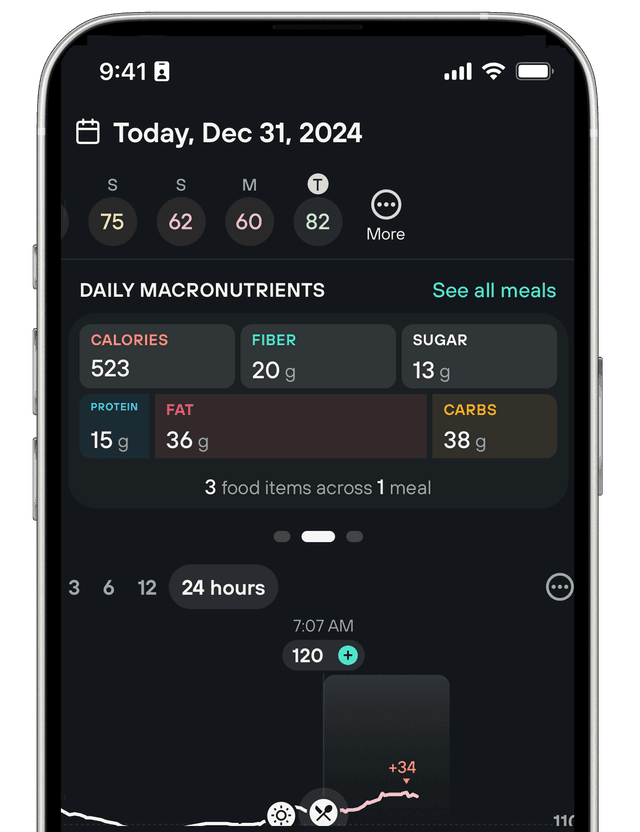
Train smarter—and see how your body responds
Resistance training and adequate protein both matter for muscle and metabolic health. Levels pairs real-time glucose data with comprehensive lab testing and personalized guidance, so you can connect what you eat and how you move to what you measure. Click here to learn more about Levels.